|
Fujimi's offerings of airframes based on Boeing's model 107, be they
CH-46 variants or variants of the Kawasaki license-built KV-107's, were/are in
my opinion, the best
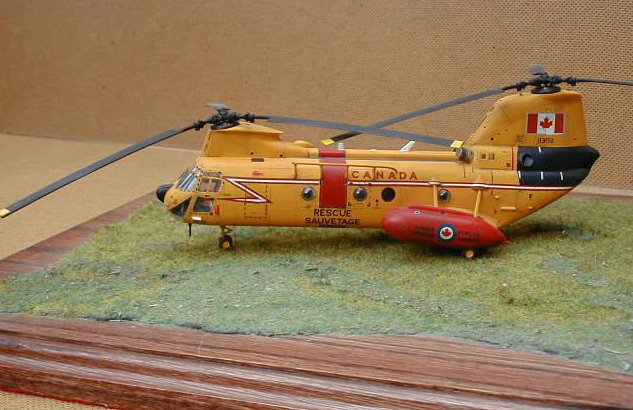
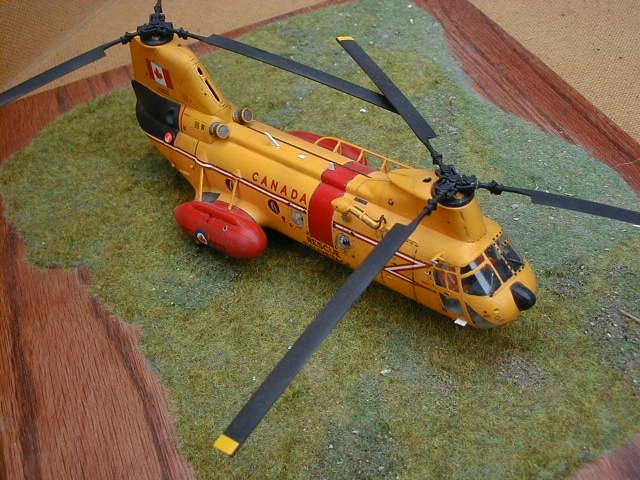
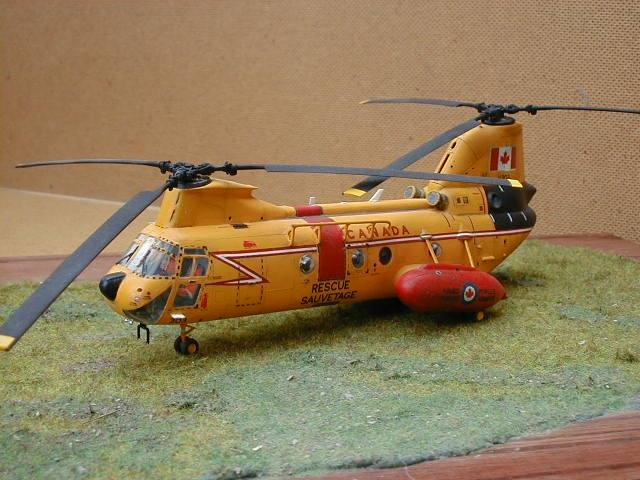
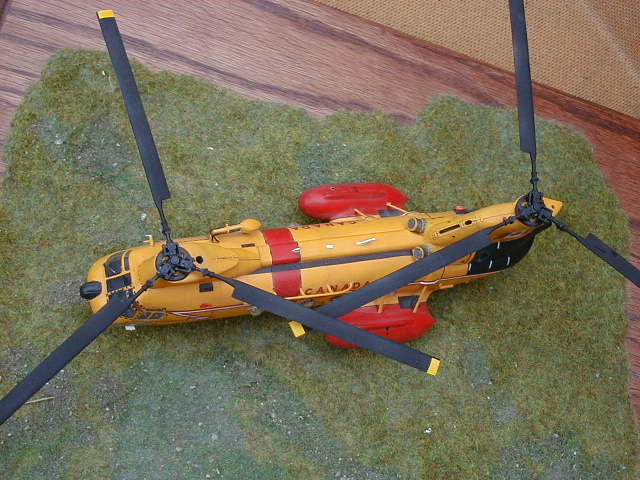
kits offered for the helicopter. My CH-113 Labrador conversion, is based
on one of their kits, the KV-107-II-5, although their -3 would have done just as
well. The only
areas of aftermarket utilized on the kit is the "cable" along side of
the external winch (car modelers are familiar with this item), P/E seat belt
buckles (paper belts) for the
crew seating, pre-shaped rod and airfoil strut by Contrail and the resin fin/APU.
The last item was a test shot, from a proposed CH-113 resin SARCUP set, kit
specific for the Fujimi kits, by Leading Edge. It matched the part breakdown of
the Fujimi kit, perfectly, simply replacing the separate kit fin and requiring
no surgery. Sadly, the Fujimi kits seem to have become scarce.
As usual in many of my conversions, a well stocked parts box, sheet
styrene and the robbing of "non-required" parts from unbuilt kits,
plays a significant part. Last but not
least, a good set of reference photos. In this case, I've posted a portion
of my photos in the walkaround link of the
IPMS
"Buzz" Beurling page.
The KV-107-II-5, as opposed to a CH-46 Sea Knight variant, was chosen as
the base kit as it included the aux. tanks and the correct transparencies,
including 6 flat and 6 bulged windows. The transparencies of the Sea Knight
kits, are quite different. CH-113 #11303 requires 5 of those 6 bulged windows.
The remaining SARCUP mods came from several sources. The nose radome was
filed/sanded from a block of laminated sheet styrene, the port HF antenna (that
"towel rack" along the side) saw the 5 supports cut from sheet styrene
via a hand
drawn pattern, capped of by a length of plastic rod, the "top hat"
engine screen originated as two 500lb bombs from an old Hasegawa Jaguar GR.1
kit, cutting the appropriate curves apart, inverting them to get the "top
hat" profile, adding a sheet plastic top and covering it all with a thin
layer of putty. When it's semi-hard, press some model screen into the
putty to get the screen pattern, then dry brush. Tank bracing, courtesy of
Contrail strut and the disk-like Crash Location Indicator from the disk portion
on the end of an un-used airborne-delivered torpedo from a Hasegawa P-3C.
Finally, the searchlight mount came from Italeri's CH-47D Chinook and the
various fuselage antenna originated either from sheet plastic or the
irreplaceable "spares box". The winch originated from a Fujimi
CH-46 Sea Knight - again via the "spares box".
The overall finish consists of Aeromaster's ID Yellow and Modelmaster's
Insignia Red. Decals were scrounged from several sources, like the OOP
Can-Force generic sheets (lightning stripe & "CANADA"), stenciling
(off various aftermarket sheets and un-used kit decals), Arrow Graphics generic
sheets (national markings & extinguisher profiles). The dashed panel
outlines came from two sources - the separator between subjects, on some
Aeromaster Decal sheets (specifically their Spitfire Mk.XIV) and a spare sheet
from the Matchbox DHC Twin Otter. The whole thing got a wash of
black Tempra paint (that powdered paint you used in grade school) that's
available in art supply stores, to give it both, that dirty appearance common to
the CAF's overworked Labrador, and to highlight the panel lines. The wash
was literally slopped on the finished model then the excess was removed with a
damp cloth. This works best on a flat finish. A finish that was more flat
than semi-gloss, was applied overall.
Scott
|
|