|
Kit
#: 5421
Price:
10.99 the last time I saw the kit
retail
Decals:
One version, 388th TFW,
Hill AFB, Utah.
Review
and Photos by:
Steve
Eggers
Notes:
Not
too bad of a kit, functioning canopy.
History:
Not to dwell on what has already been written about the F-16,
besides it being the most successful fighter program of the 20th
century and one of the most exported, the F-16 continues to be an exceptional
fighter.
The
Kit
:
Monogram’s offering of the F-16
depicts a YF-16 prototype. The kit
is molded in white or gray, depending on which time period you bought the kit
and has raised panel lines and the distinctive prototype two-piece nose gear and
two fuel tanks. Interesting to
note, is that both wings and horizontal stabs are molded into the top half of
the fuselage. Thus not requiring
any filling or sanding of those surfaces.
After studying
the kit, I decided to challenge myself. I
decided that I wanted to see how correct “looking” I could make this kit,
using what was supplied to me in the box. After
looking at various pictures of early (pre-block 15) “A” models, I decided I could do it, as
you will read here. Although, I did have to go outside the Monogram supplied
parts to get what I needed, it was nothing substantial.
Construction:
| The
first step is the construction of the landing gear, which I opted not to do. I
feel that landing gear should be one of the last things to be put on a any model
if at all possible. That is where the problem come into play with this kit.
The intake is designed in such a way that the center section of the main
landing gear bay is part of the intake. To
remedy this, I cut approximately 1/8 off of the centerline area, so I can put
the main gear on later.
The cockpit is very minimal
with just the basics, an ejection seat, cockpit “tub”, forward
instrument panel and interestingly enough, no control stick It is
molded into the pilots right hand.
There is no instrument and side console details. The
ejection seat is pretty basic and represents the early ejection seat and
not an ACES II seat.
|
| Click on
image below to see larger image |
 |
|
I painted the
cockpit “tub” and instrument panel overall light ghost gray and did the
cockpit walls on the inside of the fuselage an overall gunship gray..
The fuselage is in 2 sections, a top and a bottom.
Like I stated earlier, the wings and the horizontal stabilizers are
molded as part of the top fuselage half. This
is actually the one endearing quality of this kit. One does not have to worry
about sanding off the detail around the wings.
I kind of like that!
Next is the building of the intake section.
Like I said earlier, Monograms instructions want you to attach the main
landing gear first then attach the built up intake section.
Well, I have a bad habit of making my aircraft sit uneven, don’t know
why, I just do. So, to correct the
problem before it happens, I cut approximately 1/8 inch from the aft section of
this section, so I can add the landing gear later, then add the piece back in
after I am satisfied with the stance of the model.
The intake is comprised of four pieces.
Care needs to be taken when inserting the anti-ice vane inside the
intake. If it is not put in
correctly, it will be crooked and you will hate yourself later.
The fit is pretty good and some sanding and filling is required on the
part as well as when mated to the fuselage.
The kit
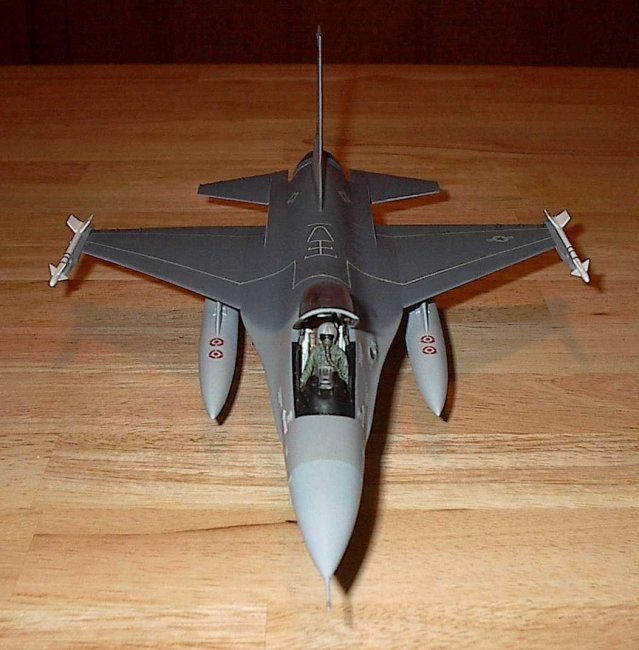
includes two external fuel tanks. These
tanks represent the early 300-gallon fuel tanks with the three fins on the aft
end of the tank. To make the kit
look more correct, I cut at the last raised panel line and “capped” off the
end of the tank with sheet styrene. This
gave the tanks a more correct appearance. The fit is good and little bit of
filling and sanding work is required here.
After the
fuselage was dry, I attached the vertical stab to the fuselage and the fit here
is less than perfect. So, a little more filling and sanding is needed
Next is the construction of the landing gear; care needs to
be taken here to ensure that the aircraft sits level. I also decided not to use the kit-supplied wheels.
To me, the Revell F-16 ADF wheels looked really good. So I put those on
this kit. They turned out really
sharp.
The final steps of construction are attaching the landing
gear and doors, engine nozzle, the nose pitot tube. I glued the two halves of
the nose gear door together to make a solid one-piece door, which is correct for
an “A”. I also found a spare
pitot tube to place on the right forward side of the fuselage, just aft of the
nose radome.
There is a fit
problem; with the exhaust nozzle. Lots of sanding is required to make a good
fit, get ready , you arm will be tired!!
Painting & Decals
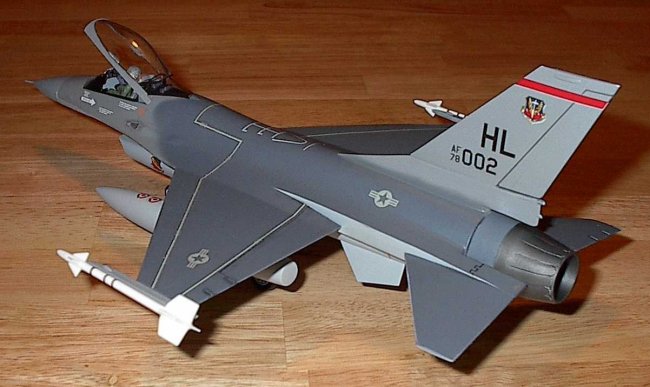
I decided to paint this aircraft in the standard four tone
gray paint scheme. I used Model
Master paints.
Dark Ghost Gray: Nose
Radome
Neutral Gray: Vertical
Stab, wingtips, and forward top of fuselage
Gunship Gray: top
of fuselage
Light Ghost Gray: bottom
of aircraft and fuel tanks
The kit decal sheet is a typical Monogram sheet. I found the
best way to put these decals on is to get the absolute hottest water that your
fingers can stand and attach them to a GLOSSY
surface. Do not use a setting
solution with these kind of decals, for some reason it just doesn’t work.
I mainly used the tail codes, command badge, Wing badge off of the
Monogram sheet. The rest of the decals, mostly stencils, came from the Revell
F-16 ADF sheet. Now that is a good decal sheet. Nice thin decals. They conformed
well to the surface. I also used
some spare Hasagawa decals from their F-16A kit.
After all the decals were applied, I used Willow Charcoal and
shaped various areas of the model. I
did this around moving surfaces, wheel wells, and the gun area.
The very last step was the exhaust nozzle. I painted it Model
Master Gunmetal buffing metalizer and buffed.
Conclusion
It’s amazing what can happen when you take a basically
mediocre kit, spend some quality time with it, and get the result I got out of
this Monogram kit. I think this kit
looks good sitting next to one for the higher priced kits.
This is a fun kit to build and a good “starter” kit
Steve
|