F4U Corsair Development
Originating in a 1938 Navy spec,
when the need to replace the F2A and F4F could already be foreseen, the Vought
Corsair was designed around an engine that also didn't exist yet: the Pratt
& Whitney R-2800 Double Wasp, a monster 18 cylinder double radial,
eventually capable of 2250 horsepower. (During the Corsair's development,
corporate reorganizations brought the Vought company into Vought-Sikorsky and
then Chance Vought, all part of United Aircraft, along with Pratt & Whitney
and Hamilton Standard.)
The huge engine dictated much of
the plane's design. Such a power plant needed a comparably big propeller to
absorb all that horsepower. Thus the 13' 4" diameter Hamilton Standard
prop, the largest fittest to a fighter at that time. The Corsair's fuselage had
to be high in the air, to give the prop clearance, But ordinary, straight wings
at that height would have implied long (and weak) landing gear. The distinctive
bent wings were developed to permit a reasonably short undercarriage.
The XF4U first flew in May 1940,
and in October flew faster than 400 MPH, a record for a production fighter. A
major re-design pushed the cockpit back 32 inches, which resulted in poor
forward vision for the pilot, at least on take-off and landing. Development
continued into 1942, when Vought delivered the first production F4U-1 to the
Navy, which didn't like what it saw, especially when compared to the
easier-handling, and very capable F6F Hellcat. The F4U had dangerous stall
behavior, had tendency to yaw suddenly when landing, and, worst off all, bounced
when it hit the deck. For use on carriers, these problems caused the Navy to
insist that they be fixed, while it went ahead equipping with the Hellcat.
But the Marines, operating from
land bases in the Solomons, needed capable new fighters to replace their aging
F4F Wildcats. By late 1942, the first USMC squadron, VMF-124, took delivery of
the Corsair F4U-1. In early 1943, they began to see combat, and were a
huge success - with speed, maneuverability, firepower, and ability to absorb
battle damage. By the summer of 1943, most of the Marine fighting squadrons had
transitioned to the F4U-1, the first operational model, fitted with a
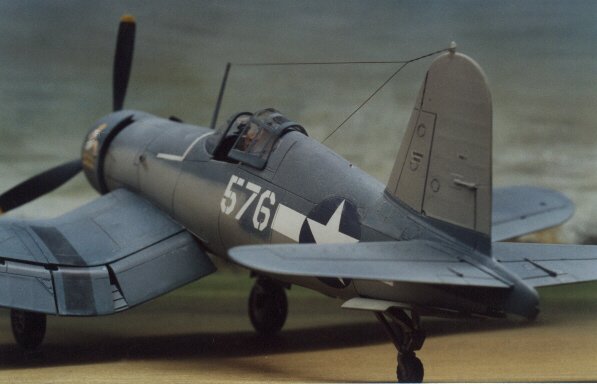
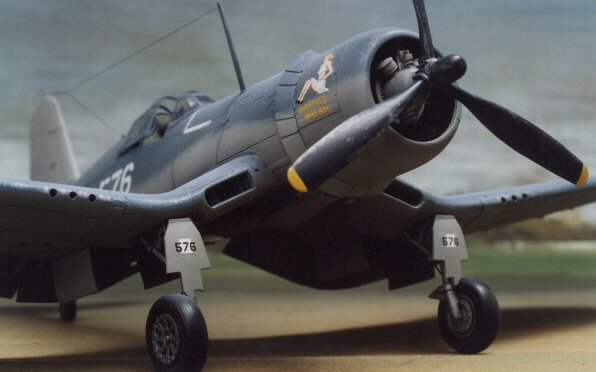
distinctive "birdcage" canopy, as shown in the detail of a plane flown
by Ed Olander (number 576). Boyington's squadron, VMF-214, switched over to
Corsairs before they started their September 1943 combat tour.
Based on combat experience,
Vought improved the next version, the F4U-1A:
Construction Notes of the
Tamiya F4U1
I chose to build my corsair out
of the box, complete with the pilot figure only adding brake lines, spark plug
wires and the Aeromaster decals. I started with the cockpit, constructing
it as per instructions and painting it with interior green and then picking out
the details using the reference colors. At this point I also went ahead
and painted everything that would be listed as interior green. I
chose to apply the dash decal rather then hand paint the instrument panel.
With lots of solvent the decal nestled down right into all the gauges.
Once the cockpit was completed I began the tedious work of the engine. I
wanted to have a go at adding all the spark plug wires to the radial engine, so
using fine fuse wire and CA glue I began gluing in place each strand of wired.
It eventually was finished after almost two weeks of on and off cutting and
gluing sessions. The engine looks pretty convincing with all the
wires in place and a nice wash and dry brushing. With the cockpit
and the engine in place I was able to glue together the fuselage halves.
Little work was necessary on the join lines, only a buffing pad was used for the
seam. Once the fuselage was together I began work on the wings. The
wings go together quite well considering they are in 4 pieces. With a bit
of patience and super glue, I was able to get the wings to fit together with
minimal filling. The next step was constructing the flaps and gluing them
in place. With everything glued together, the wings are quite heavy
compared to most other kits and when they were glued into the fuselage, I used a
bit of tape to hold them in place. With the wings and the fuselage
together the next step was to work on the landing gear. I chose to add
brake lines and followed some reference photos for placement of these.
With the landing gear ready for painting, and the final steps of the
construction completed, I decided to start with the painting.
Painting, weathering and
decals:
I chose to paint my Corsair
with a paint scheme of the F4U called "Marines Dream" of
VMF-214, Munda, October 1943. This was piloted by 1st Lt. Edwin L. Olander who
had five confirmed kills and another four probables. The Aeromaster sheet
calls for Blue Gray/ Light Gray with a Light Gray tail. I am not sure if
this paint scheme is completely accurate, but I thought it was interesting
enough to do. I started by preshading all the panel lines with flat black.
When the panel lines were dry to touch, I painted the Light Grey first and then
carefully masked it off and painted the Blue Gray. The kit was allowed to
dry for 24 hours and I went ahead and added the panel lines using a sharpened
No. 2 pencil. Lead appears a bit shiny but after the matte coat goes on
this will disappear. The next step would be a few light coats of Johnson's
Shine Magic. When the clear coat was dry, the decals were applied,
using Microsol and Microset. The plane was again left to dry sit
over night and the following day a few coats of Shine Magic were again applied
to seal the decals in and protect them from the final matte coat, which was a
combination of Tamiya Flat Bas and Shine Magic. I find this combination
works great.
Final Details of Construction:
Final construction included
adding the painted landing gear and wheels, tail wheel, antennae and antennae
wire which is made from invisible thread and the canopy which was masked and
painted. I used Tamiya lens paints for the landing lights and navigation
lights. I also chipped the paint along the wings and walk ways with silver
pencil.
I really enjoyed the
kit even though it took me some time to complete it. It was a change of
pace for me since I had been focusing mainly on Luftwaffe fighters.
Anthony
Visit Anthony's
website at
The
Model Hangar
to see more of his models.
|
|