|
Well this started to be a quick
build, you know straight from the box…. yeah right.
After reading an article in Scale Aviation Modeler that dealt with
superdetailing the kit, I had to give it a shot.
Now I’m not going to go into the history of the aircraft, because its
been done and re-done…Everyone knows that this aircraft was one of the
Luftwaffe’s work horses, and provided the Allies with a worthy adversary.
|
The
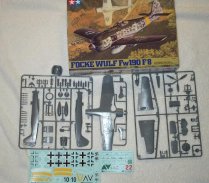
1/48 Tamiya kit is of typical quality that we have come to expect.
There are only three sprues of gray molded, flash free beautiful
styrene, and one sprue of clear parts.
The decals are comprehensive and include a smaller sheet of
stencils. Now, on to the CMK
kit. When you empty out the
box the sight of all that resin is almost overwhelming.
I had only one piece that had an air bubble that had to be filled.
|
|
|
I
don’t like resin. There, I
said it. Let me be more specific.
I don’t like most resin sets.
I prefer to scratchbuild most of the details in my models. However,
some details just can't be scratchbuilt, such as the engine, access
covers, etc. I enjoy modeling, but I am not going to spend 8 hours scratch
building an access panel when I can use an aftermarket product.
I guess I feel like I’m cheating when I use an all resin cockpit.
|
|
| One of the first
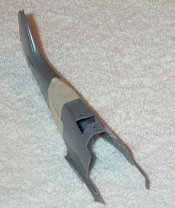
things I did was to make the necessary cuts to the fuselage. Using this
set requires you to do some surgery on the kit.
This photo to the right/below shows how much.
After chain drilling the access cover on the tail, it was off to
the cockpit. |
| Now the CMK resin tub has really
nice detail, and you could create a real gem by carefully painting all of
the switches, buttons, etc. I
chose to file off all the detail and use a Waldron detail set. This took about two nights to build and I am happy with the
results. I used decals from a
ProModeler set. The side
panels are from the Waldron set. Note
the dry transfers. I was
leery about using them, but they went on without a hitch.
The individual buttons were punched out with a Waldron punch.
If you are an aircraft modeler, you need one of these toys.
I use it for nearly every build.
I used Testors “clear parts
cement & window maker” to attach the buttons.
This stuff is stronger than white glue and has a longer set time
than super glue. It dries
perfectly clear. Once dry,
you can give the panel a light mist of dullcoat and it disappears.
The CMK kit provides no rudder pedals.
You can use the kits, or buy aftermarket pieces.
I used the kits. |
|
Next I glued the fuselage
together. You’ll have to remove a
lot of material to the model in order to get most of the major resin pieces to
fit. Take your time and constantly
test fit your pieces. After gluing
the wings on I attached the firewall. I
was very pleased with the fit. No
filler needed.
|
OK,
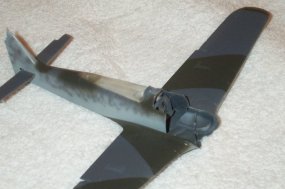
next I painted the camo scheme. This
was my first German camo scheme, and I think it came out pretty good. I
used MM enamels. I
sprayed multiple coats of future on the model and set it off to the side.
|
|
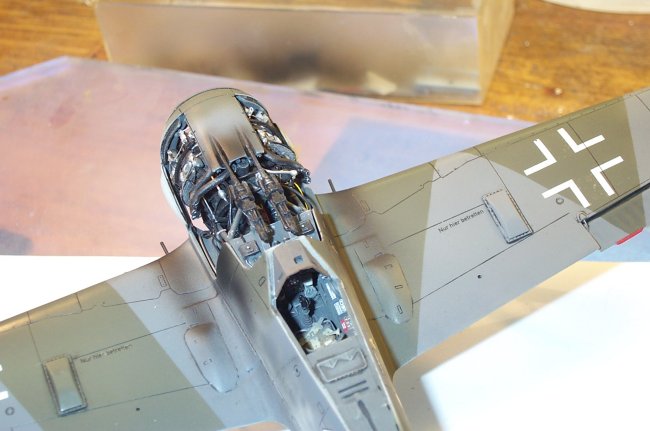
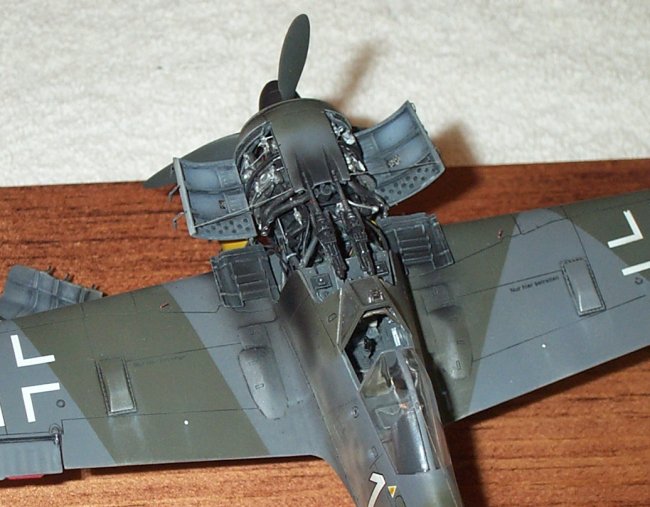
| On to the engine.
The CMK instructions can be frustrating at times.
Try to gather as much reference as you can.
I had a hard time finding good reference photos of the BMW 801.
The engine is pretty straightforward.
Do yourself a favor and keep track of the exhausts while you remove
them from the cast. I spent
way too much time fooling with the exhausts simply because I had lost
track of what was what. I
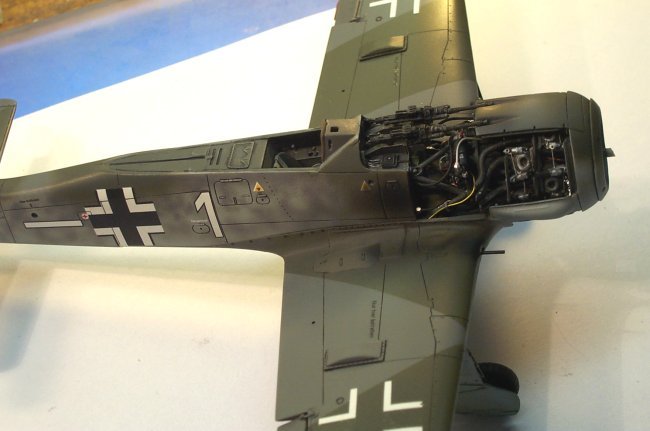
plumbed the rear of the motor with solder, wire, and different size brass
stock. I used fittings that were made for model car motors.
I can’t recall who makes them, but I am going to go to the shop
that I originally bought them from and get some more.
If you want to know the name of the company, shoot me an email and I will
get the name. They really
dress up the motor. I used
stretched sprue for the wires that connect the engine heads.
I didn’t add the pushrods because you cant see them. |
|
| I began to dress up
the firewall when I remembered the article in SAM.
There are no Machine guns or ammo boxes with the CMK kit.
Thank goodness for Squadron mail order.
I ordered a set of Aires machine guns and got them about three days
later. Everyone has a
favorite vendor. Mine is Squadron.
The turn time is unbelievable.
Next I began to scratchbuild the
ammo boxes. I used a
reference from the Walkaround book. I
used some assorted doo-dads from the spare parts box to dress it up.
All of the assorted access panels were painted and the insides
drybrushed to show wear and tear.
|
|
For decals, I didn’t use the
kits. Everyone knows how thick
Tamiya’s decals are. You would
think that by now they would have done something about it.
Anyway, I used a set from Aeromaster.
The landing gear was added
next. I used the kits tires.
To tell you the truth, they look better than the resin tires.
Finally, after shooting it with
a couple of coats of Future and letting it dry, I filled in the panel lines with
a wash consisting of dishwashing detergent, acrylic paint (Polly S) and a bit of
water. I wiped the excess with a
damp paper towel. The exhaust
stains were done using a combination of watered down acrylics shot with an
airbrush, and pastels. After a bit
of drybrushing, I was done. Not bad
for a rookie.
|
Click on images below to
see larger images |
 |
 |
I’m sure there are some areas
that are inaccurate. I had a hard
time finding reference material. Hope
you enjoyed!!
Derek
A side note:
The article that I refer to is from Scale Aviation Modeller
International. Its very helpful,
and it saved me a lot of time with this build.
Unfortunately, It doesn’t have a month listed.
The only info I can get on the magazine is that it is Volume 7, Issue 5.
|
|