|
How
Formed
on 18 December 1943, the 1ºGAvCa ( Grupo de Aviação de Caça) had its cadre
composed of volunteer FAB (Força Aérea Brasileira - Brasillian Air Force)
pilots and was commanded by Ten.Cel.Av. Nero Moura
The
Group had 350 men (43 pilots) and was sent to Panama for combat training, since
the pilots already had flying experience; one of its pilots, 2º Ten.-Av.
Alberto M. Torres, was the pilot of the PBY-5A Catalina that had sunk the U-199.
On 11 May 1944 the Group was declared operational and became active in the air
cover in the Canal Zone.
Following
the completion of its initial training, the Group was sent to the USA on 22 June
for an operational conversion course on to the Republic P-47D Thunderbolt that
was to equip the 1ºGAvCa.
The
Group departed for Italy on 19 September 1944, arriving at Livorno on 6 October.
There it became part of the 350th Fighter Group USAAF, an unit which had been
formed on 1 October 1942 in Britain. Until the arrival of the 1ºGAvCa, the
350th FG was made up of three squadrons: 345th Fighter Squadron ("Devil
Hawk Squadron"), 346th FS ("Checker Board Squadron") and 347th FS
("Screaming Red Ass Squadron"). When the 1ºGAvCa (1st Brazilian
Fighter Squadron - 1st BFS) was incorporated to the 350th FG, that unit was
subordinated to the 62nd Fighter Wing, XXII Tactical Air Command, 12th Air Force
USAAF. The call-sign for the 1st BFS was "Jambock".
What
is this?
|
The
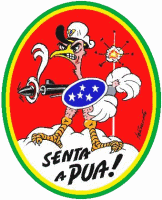
badge of 1ºGAvCa was designed while the Squadron was travelling to Italy.
Drawn
by the latter, it can be described as follows: |
-
The green-yellow surrounding represents Brazil;
-
The red field behind the fighting ostrich represents the war
skies;
-
The bottom field - white clouds - represents the ground to a pilot;
-
The blue shield charged with the Southern Cross is the common symbol for
the Brazilian Armed Forces;
|
|
-
The ostrich represents the Brazilian fighter pilot, whose face is inspired
in that of Ten.-Av. Lima Mendes, and also the stomach of the veterans of
1ºGAvCa;
-
The white cap was part of the FAB uniform at the time and distinguished
the Brazilian pilots from the other Allied pilots;
-
The gun being hold by the ostrich represents the firepower of the P-47,
with its eight .50in machine-guns;
-
The motto "Senta a Pua!" is the war cry of 1ºGAvCa;
-
The white streak, at the right, ending on a flak burst, was added later,
and represents the danger brought by the German flak (this device appeared
only on replacement aircraft).
|
In
action!
The
Brazilian pilots initially flew from 31 October 1944 as individual elements of
flights of the 350th FG US squadrons, at first in affiliation flights and
progressively taking part in more dangerous missions.
Less
than two weeks later, on 11 November, the Group started its own operations,
flying from its base at Tarquinia, using its call-sign Jambock.
The
Group was divided into four flights, Vermelha (Red), Amarela (Yellow), Azul
(Blue) and Verde (Green).
Colours
| Initially
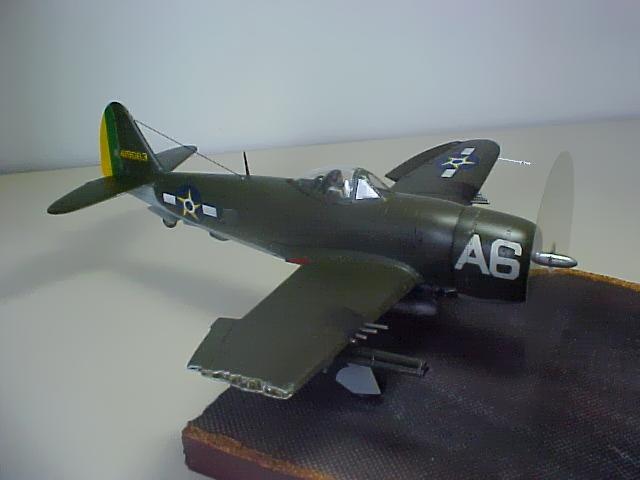
the P-47s were finished in standard US fighter colours, olive-drab (top
surfaces) and neutral grey (undersurfaces). |
| The
aircraft of the commander and operations officer were finished in natural
metal and olive-drab anti-glare panels. The badge of the Group was painted
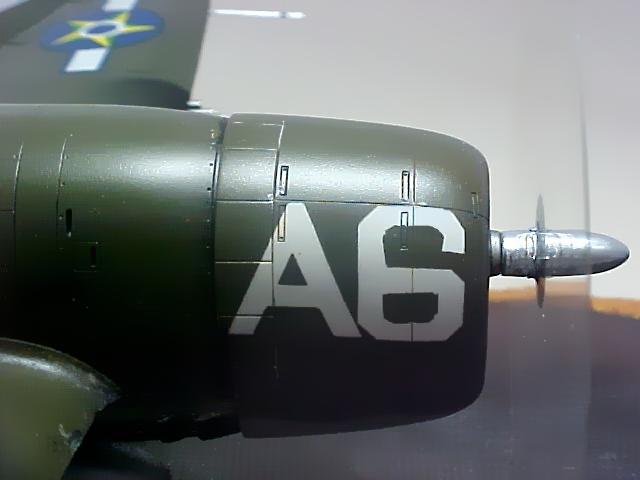
just after the engine cowling, and the aircraft code (flight
letter-aircraft number) was in white letters over the cowling.
National
insignia was in four positions, this being the US star-and-bar, with the
white star replaced by the Brazilian star. Later, replacement aircraft
were in natural metal, with olive-drab anti-glare panels, the codes being
in black.
|
|
Its
power
The
1ºGAvCa flew a total of 445 missions, 2,550 individual sorties and 5,465 combat
flight hours, from 11 November 1944 to 4 May 1945.
The
XXII Tactical Air Command acknowledged the efficiency of the Group by noting
that, between 6 to 29 April 1945, it flew only 5% of the total of missions
carried out by all squadrons under its control, but destroyed:
-
85% of the ammunition depots,
-
36% of the fuel depots,
-
28% of the bridges (19% damaged),
-
15% of motor vehicles (13% damaged) and
-
10% of horse-drawn vehicles (10% damaged).
|
Click on images below to
see larger images |
 |
 |
Canário
In
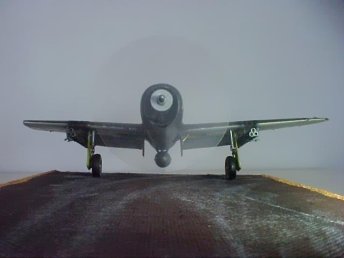
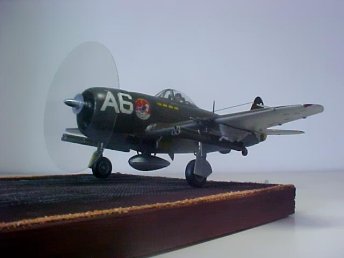
01/27/1945 the Red flight (aircraft code: "A") took off for one more
sortie, with the 1º Ten. Av. Dornelles as leader of the formation, and one
young pilot called Raymundo da Costa Canário, flying the P-47D #44-19663 (the
"A6" aircraft). Canário was originally pilot of the Yellow flight.
During
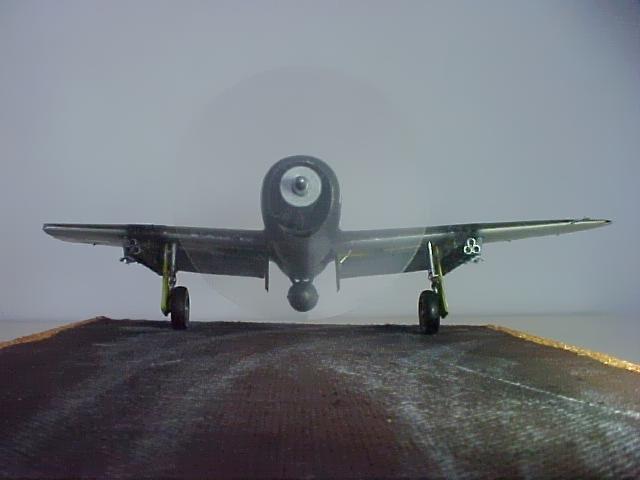
an attack at low altitude, Canário collided with an industry chimney
which fell down. In the collision the P-47 lost 1.28m (50.394") of
the right wing, but that loss of a part of the wing did not hinder it coming
back to the base.
Dornelles
was his guide, opting to fly over the Adriatic Sea: over the land there was much
Germany flak and low and dense clouds. Over Veneza some Spitfires had almost
knocked them down therefore they had not recognised them immediately
as allied pilots. After this "small" incident , Dornelles flew with
Canário until 5000 ft, keeping silence on the radio.
The
low and dense clouds made it difficult for a visual approach; when Dornelles
found a hole in the clouds he told Canário: "wait for me here. I will to go
down to have a look and and I will come back to to tell you if this airstrip is
OK!"
Well,
at age of 20, Canário ignored the acknowledgment and flew right back with
Dornelles.
A
few moments before Canário to land he heard on the radio: "abort! abort! A
P-61 Blackwidow needed to make an emergency landing!". Canário pulled up the P-47, made
another final approach and landed safely.
Dornelles
flew 89 missions (he used to say "I'll never became 90 missions) - he died
in 04/26/1945, flying his P-47.
Canário
flew 51 missions. He survived the war.
The
Kit
I
used the HTC (Brazilian special edition with Academy parts) kit of an P-47 D in
1:48 scale. The decals were made by FCM decals (a Brazilian company).
The
colour scheme was made with automotive paints: Olive Drab (uper surfaces),
Neutral Gray (undersurfaces) - both mixed by myself, White (the A6 code), Yellow
and Green (rudder), Red ("no step" area)
The
rest of the kit was painted stock, in the American scheme.
The
right wing was cut and I used plastic to reproduce the internal structure of the
wing.
I
lower the flaps and upper the left aileron.
References
-
Squadron P-47 in action
-
A lot of sites on Internet, in special A História
da Força Aérea Brasileira
-
Interview with two great Brazilian kit
builders experts in FAB, Terlizzi and Abreu
-
Interview with Brigadier General Rui Moreira
Lima, veteran of the 1ºGAvCa, 94 sorties
-
Senta a Pua - book writing by Rui Moreira
Lima
-
FAB na Segunda Guerra Mundia - book by
Luciano Barbosa Monteiro
-
Jean
|
|