|
History
When you talk about historical helicopters, the famous
UH-1 Huey comes to everybody’s mind. It's strong point being its load-carrying
capacity and the plentiful models, besides the manufactured quantity, make this
machine the most utilised by armed forces all over the world.
But
to these characteristics it has to be added that it is an old machine.
Thinking
of all these values, but above all else the fact its becoming obsolete, the American
Government thought of a substitute in the mid ‘60s.
The
UTTAS (Utility Tactical Transport Aircraft) planned the construction of a valid
substitute for the Bell 204, which had distinguished themselves during Vietnam war,
that was precisely defined “the helicopters war”.
All
the constructors, who had dealt with “the rotating wing” in their history,
participated at the competition.
Hughes
studied a prototype that was the outcome of the experience of model 500 and
model 77.
Lockheed
developed a project that was also utilised as a base for the CL 1700, unlucky in
the competition with the AH-64 too.
Boeing
worked out the model 179, after leaving the traditional formula of the tandem
rotor and, finally, Sikorsky developed the project S 70.
The
finalists were indeed Boeing with the YUH61A and Sikorsky with the YUH60A: they
were ordered three models each for the final evaluations.
Sikorsky
got the contract with the S 70, designated by U.S. Army through the abbreviation
UH60A Black Hawk.
The
first 15 models in 1979 were assigned to the famous 101st Fort
Campbell Division in Kentucky.
The
overseas sales were slow, perhaps due to the high cost, but as time passed, the
problem of obsolete machines like the Bell 212, 214 and 412 made replacement
more and more necessary. The machine was acquired by the following armed forces:
-
US
Army
-
US
Air Force
-
US
Customs
-
US
Marine Corps
-
US
Coast Guard
-
Argentina
-
Australia
-
Bahrain
-
Brunei
-
Chile
-
China
-
Colombia
-
Southern Korea
-
Egypt
-
Japan
-
Jordan
-
Greece
-
Philippines
-
Hong
Kong
-
Israel
-
Morocco
-
Mexico
-
Saudi
Arabia
-
Taiwan
-
Turkey
This
helicopter was christened in 1983 during the operation in Grenada, where the
UH60As of the 82nd Division rescued American civilians.
It was
then utilised in 1987 in the Persian Gulf with the 160th Special
Operations Regiment, in 1989 in Panama during the operation “Good Cause” and
in 1990 during the Gulf War, where it was recognised as the best helicopter in
the world.
The
last, so-called famous, utilisation took place in 1992 in Somalia during the
operation “Restore Hope”.
Versions/Models
YUH60A Prototype
UH60A
Black Hawk
US Army final designation
UH60A
Pot Hawk Model for US
Custom for anti-drug surveillance
UH60A
Credible Hawk SAR Model for
US Air Force
GUH60A
Simulator without flight capacity
JUH60A
Model constructed for evaluations and tests
YEH60A Prototype constructed for US Army for electronic war
EH60A
Final designation for ECM utilisation
HH60A
Prototype for US Air Force (single model 82-23718)
MH60A
Velcro Hawk
Primary
model for US Army to utilise for special operations
VH60A
Model to carry VIPs of US Marines
UH60B
Improved model of UH60 with improved engines and avionics;
it is not constructed in a range, but it is incorporated into the model UH60L
YEH60B
Modified model of UH60A to utilise as a platform for targets acquisition,
it is not constructed in a range
SH60B
Model for US Navy
EH60C
ECM version for US Army (66 models)
HH60D
Night Hawk Cobat
SAR model for US Air Force (cancelled)
CH60E
Model proposed to US Marines for assault helicopter (cancelled)
HH60G
Model for US Air Force similar to MH60G optimised for SAR
MH60G
Pave Hawk Model
for US Air Force for SAR combats and special operations, equipped with a drogue
and a FLIR turret
HH60J
Jay Hawk Model for
US Coast Guard with SAR functions
UH60J
Japanese model similar to UH60L with SAR functions, constructed under
licence in Japan
MH60K
Model for US Army similar to MH60G, but with a better equipment
AH60L
Flying gunboat for US Army
UH60L
Improved model of UH60A
VH60N
Presidential Hawk Model
to carry VIPs, equipped with improved avionics
and communication system
UH60P
Model for Southern Korea
UH60Q
Dust-off Hawk Medical model
S70A1
Desert Hawk Model for Saudia Arabia
S70L1
Medical model for Saudia Arabia
S70AL
Model for Australia
S70C
Model for Taiwan and Brunei
MH60K
This
is a special version of MH60 model, intended for the army to equip the 160th
Special Operations Regiment, the famous Night Stalkers.
It
differs from the original model in many details which make it unique and give a
more aggressive aspect to it.
Like
the others it has a four-bladed system, made of modern material, designed to be
very successful at enduring ballistic damages thanks to the titanium spar covered with Nomex
with a honeycomb structure.
Moreover,
blades are angled at the ends to improve the performances at high speed.
Its
propulsive system is made of two 1843 HP turbines General Electric T700-GE701, a
bit more powerful than the version T700-GE700, that develops 1543 HP; these
engines are mounted onto the opposite sides of the cabin in order to reduce to a
minimum the risk of damaging both of them with a single hit.
In
order to reduce the infrared signature, a special system for expulsion of the exhaust
gases, known as HIRSS, is mounted onto the terminal area.
The
stabiliser is bigger than the one for the UH60A and therefore it facilitates the low
speed manoeuvres better.
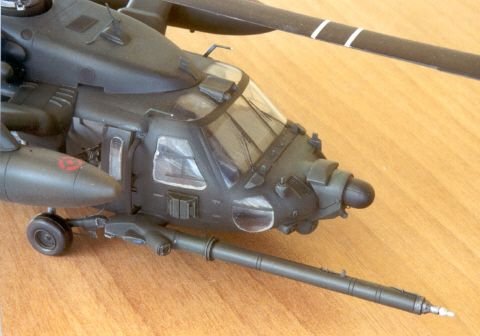
On
the right side of the nose there is the drogue, in order to have a higher
endurance for long duration missions.
Moreover,
the model K has an APQ174 (RTF Terrain-Following Radar) Radar system that can
follow the ground profile and an AAQ163 FLIR (Forward-Looking Infrared Imager)
turret.
Here
below are the technical specifications of this model:
Weight
-
Maximum
takeoff weight
24,500 pounds
-
Load-carrying
capacity 10,000 pounds
-
Internal
tanks
capacity 360 gallons
-
Internal
auxiliary tanks
capacity
600 gallons
-
External
tanks
capacity 460 gallons
Performance
-
Maximum
speed 165 mph (altitude)
-
185 mph on sea level
-
Cruising
speed 120 kilometres
-
Maximum
altitude 19,000 feet
-
Endurance
755 nm
-
Endurance
limit G Unknown
Passengers
Dimensions
-
Rotor
diameter 53.66 feet
-
Tail
rotor diameter 11 feet
-
Length
64.83 feet
-
Height
12.33 feet (principal rotor)
-
16.83 feet (tail rotor)
-
Principal
rotor surface
2,262.04 squared feet
Engines
2 General Electric T700 GE701
Maximum power 1843 HP
Model
Construction
The
idea to work out this model entered my mind while I was reading the book
“Black Hawk Down” by Mark Bowden about a mission by the Rangers and
Delta Force in Somalia in 1992.
As
I knew I had the UH60 by Academy in 1/48 scale on a shelf, I began to work out
the project in my mind.
After
opening the box and checking the contents, I was very disappointed in realising
that some pieces were missing; I probably did a careless purchase in a little
market, attracted by the price and the beautiful box when I was younger and more
naive.
Never
mind, the Academy is still on sale and I chose the particular version of MH60K.
The
box is full of 7 sprues plus 1 for transparencies for a total of 214 dark green
plastic pieces, not the best material.
After
carefully examining the pieces for the model K modifications, I had the
impression that the kit designer had probably never seen an MH60K, as these
pieces are completely wrong.
Fortunately
Cobra Company sells a conversion set, #CC48002, dedicated to this model.
It
is made of 27 yellow resin pieces, perfectly moulded without shrinkage or
bubbles. Some of them are intended for exterior modifications and others are
intended to improve the kit interiors, which are a bit too poor.
Moreover,
for some external details I used the Eduard 48 081 Photo Etch set, while for
the internal ones I used the Eduard 48 094 set, although it would have been
unnecessary given the interior quality of Cobra.
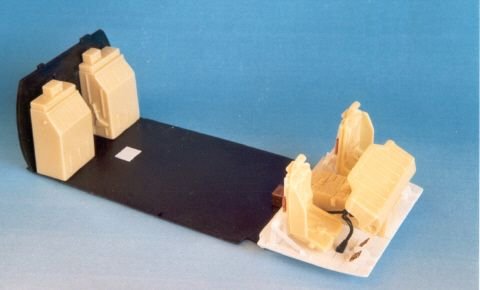
The
construction began with the interior, by completely cutting the anterior part of
the floor to reconstruct it with the correct size pieces made out of plasticard.
The
pilots’ resin seats, already equipped with the lateral armour and the belts,
have been further improved with the support structure and the shock struts.
The
power switchboard provided by Cobra is to be largely blunted in its anterior
part, otherwise the great glass might not close onto the fuselage.
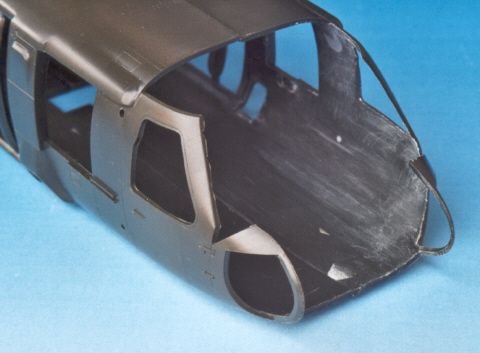
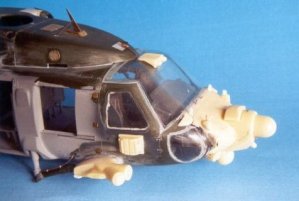
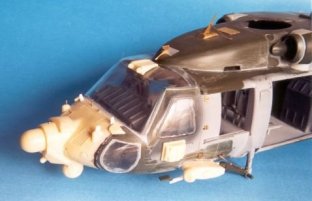
The
most difficult part of the conversion is the installation of the new nose.
Following the instructions attached to the Cobra set you must cut the nose up to
the lower window but, according to me, in this way you then find yourself in an
uncomfortable position as you have to glue a side of the transparency to the
resin.
I
preferred to leave a small frame and slightly blunt the nose at its sides.
In
the interior you have to build with plasticard the bulkheads which hide the main
landing gears; in fact, without the bulkheads the gears are visible.
In
the posterior part the big instrument system cases and the passengers’ seats
have to be set up. I kept only the seat bottom from the original piece and I reconstructed
the back and the safety belts.
I
made some modifications to the ceiling, by adding the upper resin switchboard.
|
Click on images below to
see larger images |
 |
 |
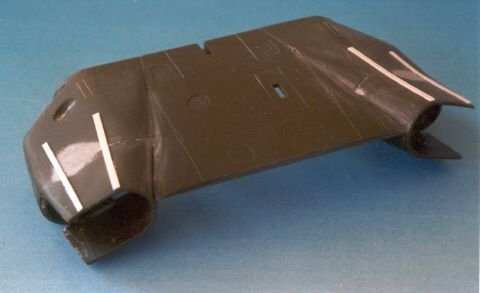
Other
operations on the fuselage were the opening of the moulded grates in the back
side and their replacement with a very thin metallic grid.
The
engine section was improved with discharge channels by folding an appropriate
Evergreen bar.
The
air intakes are to be opened with a blade.
At
this point, after setting up the glasses, I assembled the two semi-fuselages and
the nose, gluing everything with kilos of putty.
As
some pictures show, I utilised some grey plastic pieces from the UH60 kit and
some green pieces from MH60K kit: the grey ones, in fact, are better and with
fewer extraction signs, maybe because they are younger.
As
for the main rotor, some hydraulic tubes and the upper rotor side, that was
missing at all, were added to it.
The
lateral nibs were replaced with the Cobra ones, that are much more realistic.
On
the right side I added the supply bar, that was also improved by basket
hydraulic cables.
On
the left side I added a pedal, that I reconstructed in the right shape with
plasticard.
|
Click on images below to
see larger images |
 |
 |
The
tail side required a work of knife and blade, as I replaced the sensors with
resin ones.
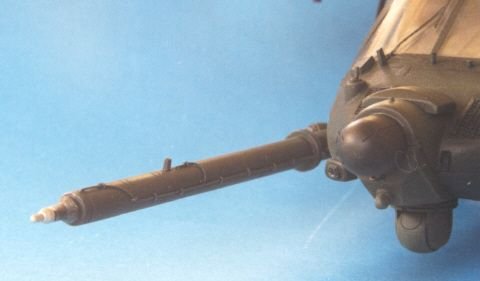
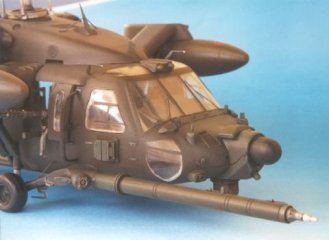
As
for the armament, I chose the 7.62 mm Miniguns GAU-2B/A to install on the
lateral windows; to this already good piece of the kit I added only the
cartridges sleeves.
Before
starting the painting, I set up all those particular details as grates, blade
and an innumerable number of antennas both on the front and the back side: in
fact the helicopter is full of them as there are precisely 57 of them.
|
Click on images below to
see larger images |
 |
 |
Painting
The
pilot cabin is almost totally black; for the switchboard and the bulkheads I
utilised the dull black of Tamiya.
The
seats cushions are brown, but they can also be coloured in black, while the
safety belts are dark grey.
For
the back cabin I utilised the grey colour, a part from the big cases that are
black; on everything I did an oil washing and a slight dry brush, in order to
create the right dirty-usage-effect.
The
real problem in colouring is the exterior, in fact this model is very dark.
After
listening to different opinions, most of which agreed on the fact that the
difference between green and black is very small, I chose a combination of these
colours.
In
fact the instructions by Academy indicate too light colours, while the
instructions of other trade marks concerning this colouring scheme indicate too
bright green colours.
Furthermore,
as this helicopter was utilised in the desert, it suffered the sand abrasion too,
therefore I utilised a very dark green but, at the same time, I tried to add
some light nuances.
|
Click on images below to
see larger images |
 |
 |
After
colouring the whole machine with Tamiya XF19 to check the possible seam flaws too, I sprayed the model with a mixture of XF58 at 70% and a XF1 dull
black at 30%.
At
that point I polished the model with Tamiya polish several times, in order to
set up the few available decals and some stencils taken from decals bank.
After
patiently waiting for the perfect dryness (we all know how fingerprints are
annoying) I did some washings in the most hidden points with a very long Brown
Van Dick, while with some oxide Green powder, that I bought in a fine arts shop,
together with a brush stolen from my wife’s make-up box I did a slight dry
brush on the whole model, in order to give depth to shapes.
|
Click on images below to
see larger images |
 |
 |
Then,
with the Black powder of the same trade mark, I toned down the green colour and
I coloured the wheels, the lower surfaces and the wing tanks struts in brown.
The
wing tank struts have been coloured with a different green, in fact it is not
rare that they are taken from other more or less utilised helicopters.
I
polished the whole model with Pebeo satin varnish and I created some scratches
with some touches of silver and grey: finally I was finished.
A
warm thank to Massimo Cestaro for his valuable advice about “the rotating
wing”.
Bibliography
-
Black
Hawk Mark Bowden
-
The
modern war Luttwak Koehl
-
UH60A
Walk Around Squadron / Signal Publications
-
Aeronautical
and Defence Magazine Monografie Edition
-
Planes
Magazine Delta Editor
-
Take
Off De Agostini
-
Combat
planes De Agostini
Internet
My
Club
4 Gatti di Arzignano (The four cats of Arzignano)
website address is www.quattrogatti.it
Davide
|