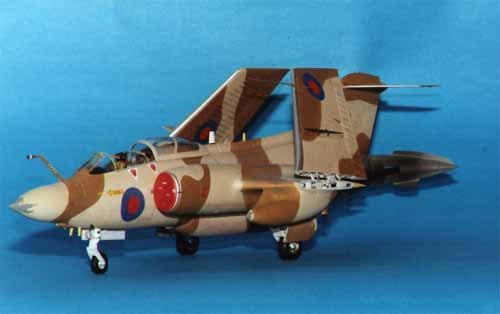
|
The Airfix kit was made in 1994 and when it was on
the market many people defined it as a "jewel". The reality is
quite different, because even if you decide to build it straight from the box
it's a very hard work.
The panel lines are heavily engraved and the
surface is grainy and wrinkled. To improve my kit I used two Eduard sets: the
48-130 and the 48-132.
Cockpit.
The ejection seats are good, so only the seat
belts were added. The cockpit received the biggest quantity of photo etched
parts and a good number of scratch built details, especially the control stick
molded oversized. A little fire extinguisher was added on the left side of the
cockpit and the seats have been placed ( as in the real plane ) out of
axis: the pilot seat 1 mm circa toward left and the navigator 1 mm circa
toward the right.
The two fuselage halves, in my model, were
deformed so it was necessary to bring them in the original shape with the help
of a good quantity of plasticard rounds. All external surfaces were
sanded to level the engraved lines and smooth the grainy plastic without
touching the rivets.
I made the inferior part of the body longer 1.5 mm
circa, just behind the big tank to provide a correct fuselage alignment and a
lot of details, not realistic, have been rebuilt or scratchbuilt.
Wings.
Normally, the ground configuration of the Buc is
with the wings folded and the air brake opened.
To represent this configuration it was necessary
to do a lot of work to make the structure more solid, with only
photoetched parts it should have been possible. To simulate the
supporting longeron of the wing I used a thick staple ( the type you use for
cardboard box), folded with an angle of 120°.
|
Click on images below to
see larger images |
 |
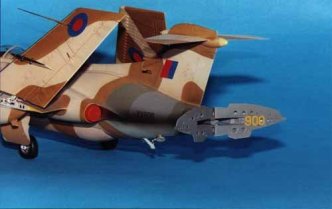 |
| All p.e. parts have been strengthened
with epoxy glue. The rear airbrake has been reproduced by Airfix with many
inaccuracies in the shape and in the internal structure, but all the
corrections were not too difficult: the only important thing was to
work with the pictures of the brake on the workbench.
The landing gear received a good amount of
scratchbuilt detail as well as the front wheel.
The gear bays were also detailed with the
help of Eduard p.e. parts.
|
| Click
on image below to see larger image |
 |
|
Painting.
In 1977 the RAF decided to participate at the RED
FLAG in Nellis with some Buccaneers of the 208th Squadron.
With the prevision of desert missions the aircraft were overpainted with more
adequate desert colors over the original camouflage till the undersurfaces.
| The colors used in Nellis
were manufactured with the intention to allow for easy removal once the
Buccaneers were back in UK. But, they didn't recognize the power of the
Nevada sun: as a big oven, the sun made the colors so hard that it was
really difficult to remove them after.
The colors used were: over the Dark
Sea Grey the Light Stone B.S. 361 similar to the
Tamiya XF57, lightened with a 20% of white, over the Dark Green B.S. 641
a classic Dark Earth B.S. 450 using the corresponding Aeromaster
color.
|
| Click
on image below to see larger image |
 |
|
The decals are those from the box and they have
a great attitude for silvering.
This model is not a milestone of the
English manufacturer and anyone that wants to launch himself into a
superdetailing adventure, well this is the right kit for just such an
adventure!
Francesco
|