|
Last year, after the 9-11
terrorist attacks, I was recalled to active duty.
I ended up at a base with a fairly good MWR (Morale, Welfare and
Recreation) hobby shop, which inspired me to start building 1/72 models,
something my father used to do, but which I hadn’t done in many years.
Besides my professional
interest in Soviet-bloc military equipment, one side of my family came to the
U.S. from Czechoslovakia in 1946, so I’m particularly interested in equipment
used by Czechoslovakia or the Czech Republic.
Five of my model projects over
the past year were of Czech subjects, and today (28 October) being Czech Independence
Day, I felt moved to share them with the ARC community.
(It’s amazing the little mistakes you don’t notice until you take
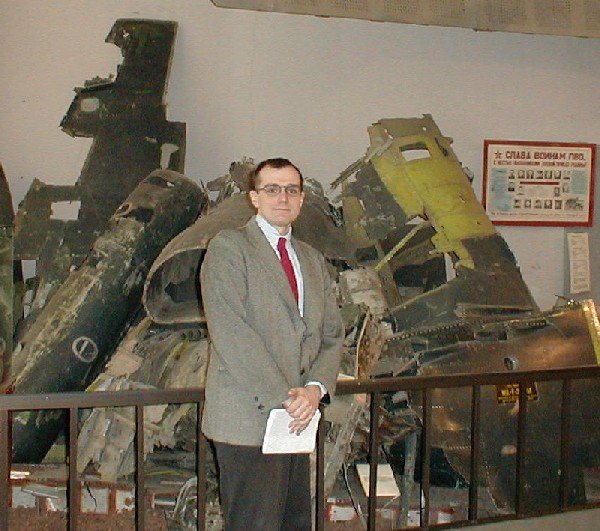
close-up photographs…) Directly below is a picture of me.
Share and enjoy,
Charles
Il-10:
Second generation second-generation sturmovik attack aircraft
(NATO reporting name BEAST). After
the Soviets stopped production, they transferred the tooling to Czech Avia,
which continued producing the aircraft as the B.33.
It was the last piston-engine combat aircraft in the Czech Air Force,
finally being retired in the 1960s.
KP kit out of the box, with
Model Master acrylics and spray. This
was one of KP’s older kits in the smaller boxes that are now hard to find.
Considering the legacy of shoddy communist-era manufacturing that I’ve
found with many model manufacturers in the former Soviet bloc, KP’s kits have
been consistently good quality – although the decals in the older kits
sometimes leave a bit to be desired (note that the white ring around the
national roundels is much too thick). This
was only my second project after returning to the hobby.
The antenna wire is made from coarse thread that I had in my uniform
repair kit, and it looks pretty fuzzy; I
may replace it with nylon thread at some point.
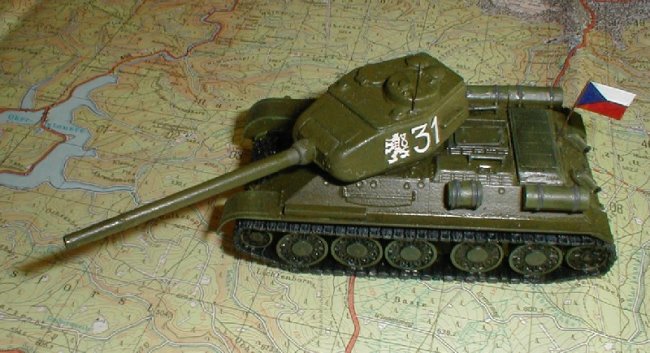
T-34/85:
Shown in markings of 1st Czechoslovak Armored Brigade,
Moravsky Ostrava, circa April 1945.
AER-Moldova
kit with model-master acrylics and spray. Additional
antennae and flagpole made from fishing line.
The kit had the usual disadvantages of former-Soviet-bloc manufacture:
some poor fit (especially in the turret) requiring lots of sanding and
some compromises on what were supposed to be moving parts (e.g. gun elevation).
On the plus side, it had a staggering number of decal options with
specific historical identification for each – something I find is likewise
typical of kits from eastern Europe.
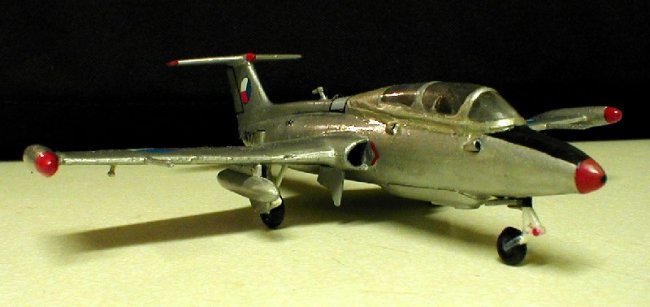
L-29R:
Recon version of Aero Vochody L-29 Delfin trainer (NATO reporting name
MAYA). Can be distinguished by
wingtip fuel tanks and camera blister under the cockpit.
Bilek kit out of the box, with
Model Master and Armory acrylics. Fair
quality kit for the price (less than $5), but the canopy was an atrocity –
flimsy blister-pack-type plastic with a great deal of excess that was difficult
to trim or sand without wrecking the canopy itself.
Fortunately it came with two, so I could afford a mistake, but I was
still unsatisfied with the fit, as can be seen in the photograph.
The instructions said the R version used both seats, and I went with
that, although I found some conflicting information suggesting the R version had
only one seat.
MiG-21F:
Known as the S-107 in Czech service and manufactured under license.
NATO reporting name FISHBED-C.
Airfix kit with Model Master
aluminum metalizer and acrylics. Nose
gear, main wheels and AA-2 missiles from an Academy MiG-21F kit.
Ejection seat from MiG-21R kit (below).
Pitot tube fashioned from scrap after the one that came with the kit kept
breaking. Airfix gave their MiG-21
kit the easiest rating, and I bought it after a failed project when I messed up
the Academy kit and needed something easy to restore my confidence.
Unfortunately the Airfix kit was simple to the point of being flimsy and
toy-like, but with the Academy parts and some careful trimming made it at least
presentable. The ring around the
national insignia were again far too thick, but I tried to trim them with mixed
results.
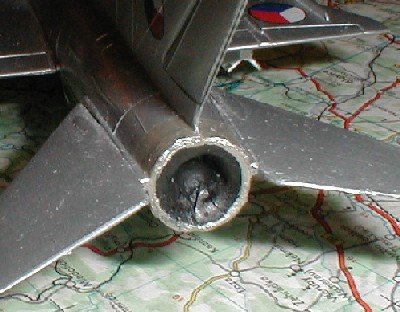
The worst part was the engine
nozzle; I used materials on hand
(paper and putty, painted black) to fashion something that at least vaguely
resembled a burner can. (Potential
scatological humor is left to the reader’s imagination.)
I later learned that Eduard makes a detail kit for Bilek’s MiG-21F that
probably would have worked for the Airfix kit too.
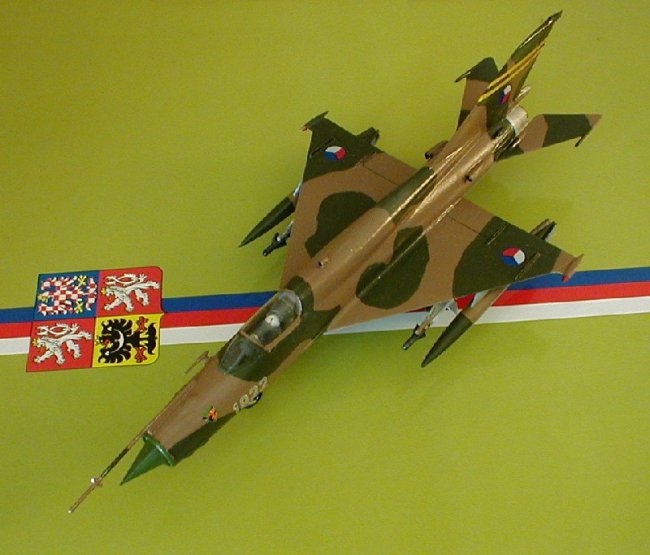
MiG-21R:
Reconnaissance version of the MiG-21, with semi-fixed camera pod under
the fuselage and wingtip warning receivers.
NATO reporting name FISHBED-H.
Eastern Express kit with model
master acrylics and Czech roundels by Propagteam.
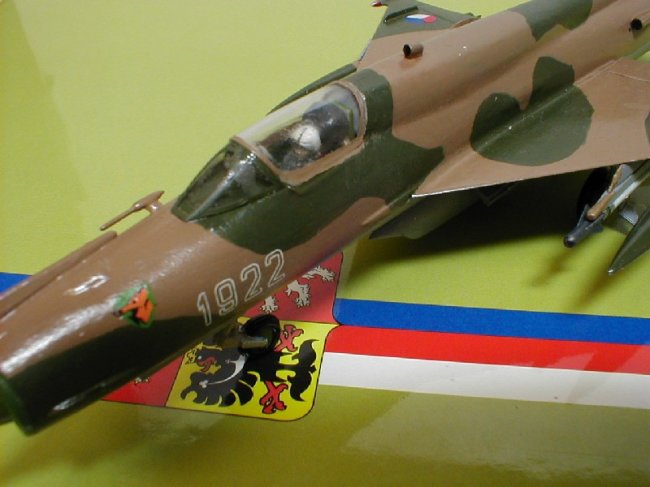
Pilot figurine from the Academy MiG-21F kit mentioned above.
Strangely, the kit included no guidance for paint scheme or decal
placement, and the only prototype photo I could find of a Czech FISHBED-H showed
bare metal. (If not for this one
picture I wouldn’t have known to apply the unit nose-art, which looks like a
fox or aardvark or something – if anyone knows more about it, please let me
know). I compromised by applying a
current Czech/Slovak MiG-21MF tan/dark green camouflage scheme.
|