|
Ever since the Matchbox's kit came out, I wanted to do my favourite Skyraider
version.
Due to several factors of which was the poor cockpit, thick canopies and lack
of surface detail I was detained from starting it.
Then things started to look brighter; Cobra Co. came out with a complete
cockpit set.
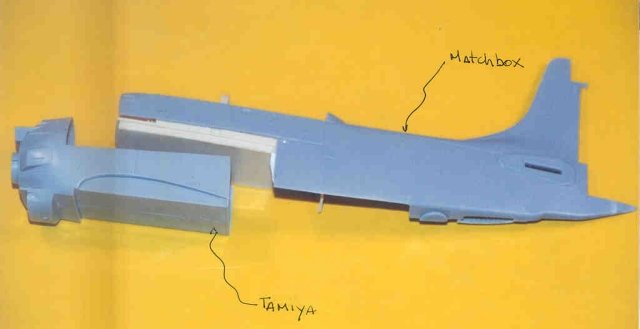
Later I found and read Thomas Cleaver's article on how he mated the Tamiya
wings and centre section to the Matchbox kit. That did it! The
IPMS/Mexico Nationals were due soon and wanted to do it for this special
occasion.
The first doubt that erupted was when my good friend Fotios Rouch sent
drawings that showed what could be carried on the huge aft compartment.
I opted for the stretcher version, but that meant that I had to open the aft
canopies in order to show the inside.
Matchbox's canopies are so thick that it wouldn't look scale-wise
correct. I thanked him for the drawings and decided on leaving the
canopies closed. He suggested that if I wanted to show them opened,
Squadron had the AD-5 vaccuformed canopies available! That did it for me, I
got several sets from them, so I could cut them up.
The second doubt erupted then, which version. Navy or USAF? I have a
photo of an USAF AD-5 flying along side a Jolly Green Giant HH-53 during the
Vietnam War from the 602nd SOS. Matchbox' decals were not that good and
Aeromaster's set was long gone from production. Fortunately I found a
modeler that didn't want the USAF version that I liked.
Thanks to Dana Bell, he mentioned that the correct FS colour for that AD-5 was
36473
and not 36440 as stated in the decal instructions. He also mentioned that they
didn't have white lower and upper control surfaces, even though they were
acquired from the Navy.
And to complete the information, that " As a rule of thumb, if the A-1 is
in overall grey and has the larger size national insignia, the "USAF"
marking would be above the right wing and below the left wing. When the
smaller, fifteen-inch insignia was introduced, the "USAF" markings
were usually eliminated. There are, of course, always exceptions".
Armed with this information, I decided to tackle
the project.
As the photos show, the cuts were made using a
jeweller's hacksaw. I decided to first fit the Cobra's cockpit into the
Matchbox's fuselage. Before closing it, the Tamiya's aft wheel well was
chose instead and glued in place, taking care to widen the "M"
opening. (From here on "M" is referred as Matchbox and "T"
as Tamiya).
The front "T" fuselage had already been
glued together. When "M" &"T" fuselages were dry it
was time to couple them making sure everything was aligned.
Thick plastic strips were used to reinforce the joint and CA glue was chose
instead to glue the fuselages together.
The "T" wings were the next step. AD-5s
had a circular wheel well cover. Using thin sheet stock, it was glued in place
and the tires were laid on top tracing their outline. Taking care of not
damaging the sheet plastic, the circular openings were carved out.
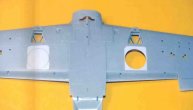
Having done that, the glued wing halves were "presented" to the
"T" front fuselage. The "M" speed brake well was
interfering with the much more detailed "T" offering, so it was
"hacked" away. The result, as seen on the photo, was a big gap that
had to be filled with plastic stock reinforced from inside.
My AD-5 didn't carry the round antenna found on
the "M" lower fuselage. Now I could sand away and leave everything
flush and smooth.
| Click on images below to
see larger images |
 |
 |
 |
Having done that, my attention turned to the upper
fuselage.
The first thing that is noticed, is that the
"M" spine comes without the oval shaped inlet used for the aft
environmental control system. After reviewing several photos, and having
determined the area where the opening was to be, my trustworthy dental
handpiece was used. Since I was working in that area, the holes for the
antennas and static boon were drilled out.
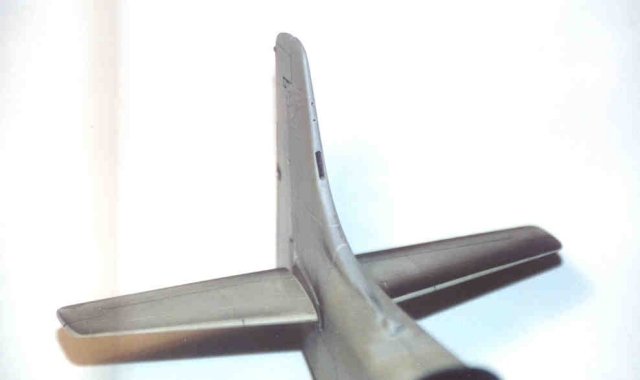
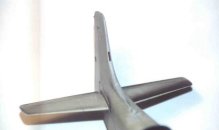
The "T" horizontal stabilisers' glue
tabs were narrowed so they could be placed even with the rudder's leading
edge.
The upper "M" elliptical antenna was
left in place.
Next, we move to the front fuselage, where things
started to look bleak.
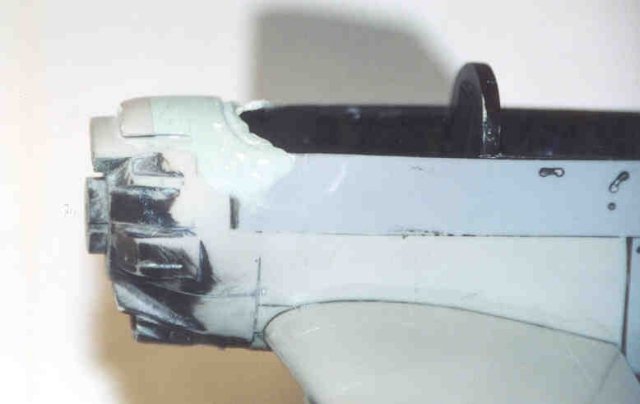
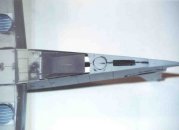
Two things had to be done in this section. First, match the "T" air
intake and second, start adjusting the front canopy.
Well, in order to do the first part, a lot, and I
mean, a lot of "T" plastic has to be removed to make the intake fit
as per the actual photos. I had to place a plastic "roof" so that
the epoxy putty used wouldn't cave in on me once the sanding started.
After the putty was still malleable, the front canopy was presented and the
necessary trimmings were carried out.
Let me tell you that I was very tempted to throw the kit into the wall!
The putty kept sticking to my dental tools; even though I kept dipping them in
water. The intake moved in one way and the canopy in another! But
eventually time came to shape the putty and the indentation for the front
canopy remained in place. The Cobra's instrument panel is wider than the
"M" opening, so a lot of sanding and test fit had to be done before
cementing it into place.
| Click on images below to
see larger images |
 |
 |
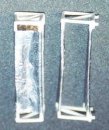 |
The stretchers were next done, using rectangular
plastic strip and lead dental X-ray foils for the canvas. (BTW, when you next
go to your dental visit, ask your dentist not to throw the lead foil used on
the X-ray film. They come in 2 sizes and some are textured. Excellent for seat
belts, tarps, etc.) Buckles came from an Eduard PE set.
Time came to start smoothing and re-engraving. When done, black acrylic was
sprayed to check for blemishes and to start shading panel lines. A few
retouches had to be done on the speed brake area with CA glue and accelerator.
When satisfied, Model Master's FS 36473 was shaken
up from it's long sleep and thoroughly applied with my trustworthy Paasche H
airbrush. Leading wing edges were Alclad II steel sprayed.
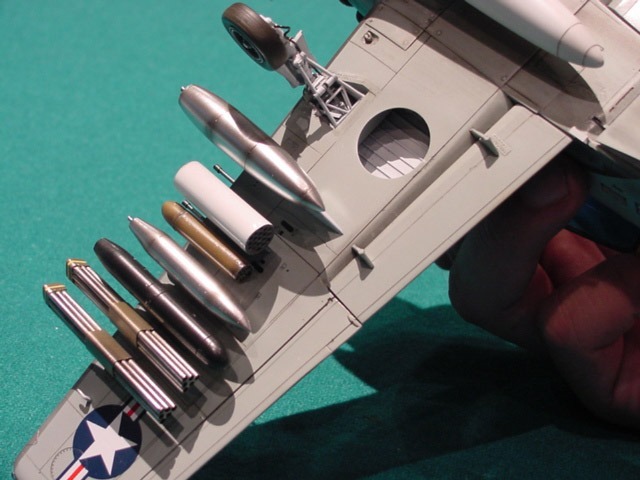
Time again to decide what type of armament was
going to be used. 'Cause let me tell you, an unarmed 'Raider is like seeing a
de-fanged viper!
Fortunately I had saved for this special occasion
an old KMC A-1 H/J weapons set that included and decided to place:
2 LAU-3A rocket launchers
4 CBU-14A/A cluster bomb units
2 SUU-11A/A minigun pods
2 BLU-10 napalm canisters
2 Mk-77 Mod 2 napalm bombs
They were wire-secured to the "T" 's
pylons, thus avoiding knocking them at any moment.
Main landing gears were detailed and the
"M" forward wheel doors were used and decided, even though it's
impossible to determine if my sample had them, landing lights.
The dreaded time was close at hand!
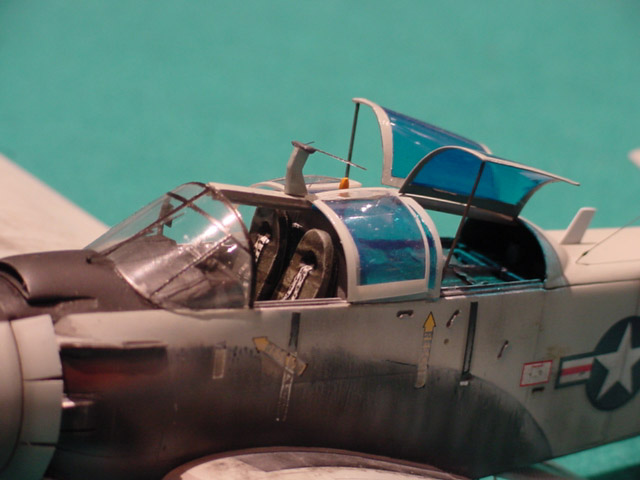
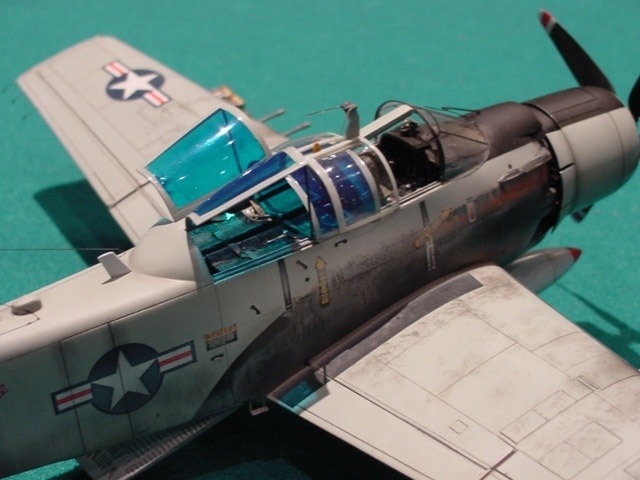
Cutting, painting and attaching the vaccuformed canopies. The cutting was
easy.
Next came the painting part. Since the AD-5 had the aft canopies blue tinted
glass to reduce sunlight exposure, it was easy to assume that a light clear
acrylic blue mist was going to do it. Wrong! These canopies are not made of
clear polystyrene and thus the clear blue paint
just didn't want to stay in place. A lot of little " blue islands"
formed spoiling the appearance. Luckily I had an extra pair just in case. I
decided to first coat them with Future and after several days, again sprayed
the clear blue. Holy remedy!
After a week's long drying time, it was time to attach them using CA glue.
Antennas and static discharges were replicated
with black nylon thread. The kit's propeller was replaced with a Cutting Edge
sample and for exhausts, a set from Moskit was employed. "T"'s
arrestor hook was used instead of the original one. Several diameters of
hypodermic needles were necessary to do the gun barrels, landing gear oleos
and static boom. The flaps were set in the elevated position that is correct
for parked Skyraiders.
And for the final touch, the windshield wiper was cannibalised from the Eduard
AH-64
Apache PE set.
After everything was in place, the final touches
were done with several pastels' shades.
A seal with Dullcoat was all that was needed to avoid smudging them.
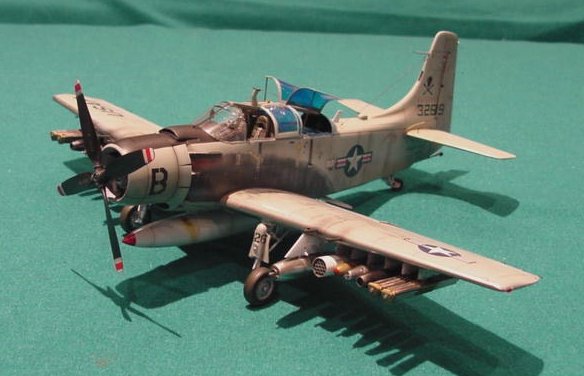
So here you have it. An AD-5 Skyraider that took
some time and effort to finish but worth it.
Acknowledgements.
I wish to thank several individuals who helped
with this project.
First and foremost to Fotios Rouch, that without his guidance and
encouragement,
I would have never started. Hat's off, filarako!
Next comes Tom Cleaver, who paved the way.
And last, to Guillermo Díaz de León, photographer extraordinaire.
Eli
Zotz
Decals
|