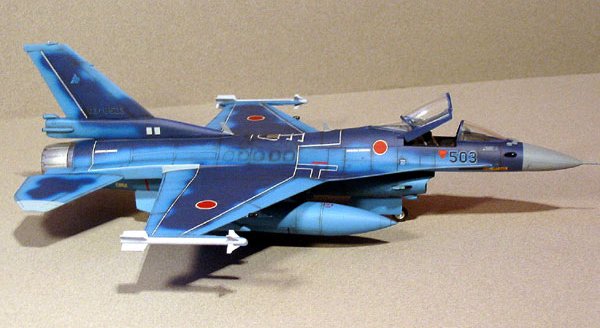
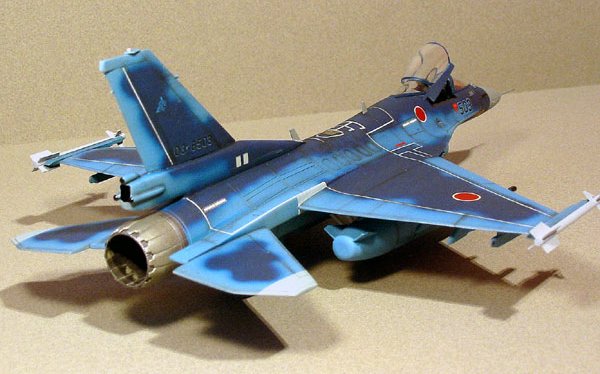
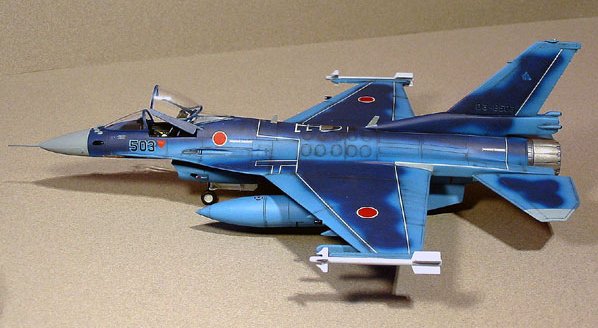
The F-2 Support Fighter is a multirole, single-engine
fighter aircraft produced for the Japan Air Self Defense Force. It was
co-developed and is now being co-produced by Mitsubishi Heavy Industries (MHI)
of Japan and Lockheed Martin Aeronautics Company (principal U.S. subcontractor
to MHI).
Based on the design of the Lockheed Martin Aeronautics
Company F-16C/D Fighting Falcon, the F-2 is customized to the unique
requirements of the Japan Defense Agency. Although capable of both air-to-air
and air-to-surface roles, the F-2 emphasizes the air-to-surface role because its
primary mission is sea-lane protection.
The F-2 has a wing area enlarged approximately 25 percent
over the F-16 wing area. The larger wing allows more internal fuel storage and
two more weapon store stations than the F-16. Japan elected to fabricate the
wing from graphite epoxy using state-of-the-art co-cured composite technology to
maximize the strength while minimizing the weight. In addition to the larger
wing area, the F-2 fuselage has also been enlarged approximately 16 inches over
that of the F-16. The horizontal tails are also larger.
Significant hallmarks of the program are the technology
transfer and the workshare between the two countries. As agreed, Japan is
responsible for producing approximately 60 percent of the aircraft and the
United States is responsible for producing approximately 40 percent.
Lockheed Martin Aeronautics Company served as principal
U.S. subcontractor during the development phase of the F-2, then called the
FS-X, and has been significantly involved in the production of the aircraft
since 1996. The F-2, a replacement for the MHI F-1 Fighter, is based on the
design of the F-16C/D aircraft.
Japan’s government plans to acquire 130 F-2 aircraft.
Production deliveries began in 2000 and will continue beyond 2010.
The F-2 Defense Fighter is the result of a joint agreement
between the governments of Japan and the United States to co-develop and
co-produce a new support fighter for the Japan Air Self Defense Force. The
government of Japan has overall F-2 program responsibility, and the program is
completely funded by Japan.
Lockheed Martin Aeronautics Company is responsible for
developing and manufacturing the aft fuselage, the wing leading-edge flaps, the
stores management system, the data entry electronics unit, and portions of each
set of avionics support equipment, including some components. The company is
also responsible for manufacturing 80 percent of the left-hand wing boxes, which
is the major portion of the wing, and for other ground and on-board equipment.
Mitsubishi Heavy Industries (MHI) is the prime contractor
and has design responsibility for portions of the airframe and avionics, the
digital flight controls, and certain support equipment. MHI is also responsible
for overall systems integration.
Key Japanese subcontractors include Fuji Heavy Industries
(FHI) and Kawasaki Heavy Industries (KHI). FHI is responsible for developing the
aircraft nose cone, the composite upper skin for the wing, and the horizontal
and vertical tail assemblies. KHI is responsible for the center fuselage.
Ishikawajima Harima Heavy Industries (IHI), another Japanese participant,
provides engines under license to General Electric of the United States. All
components are assembled by MHI at the Komaki South Plant near Nagoya, Japan.
If you are interested in only modern jets, just how many
of those F-16s, F-15s or F-18s have you built? Turkish Air Force is primarily
flying two types of jets, F-16C/D Fighting Falcon and F-4E Phantom II, being a
professional modeler, most of the orders that I receive are about these two
jets. I am honestly bored of building hundred copies of same aircraft each. I
was thinking about giving a break and building something completely out of my
league. Guess what? For a chill build, I decided to make an F-2, even though it
is an F-16 based fighter, and even though it looks and feels like F-16, it is
“compeletely different”. Yeah right!
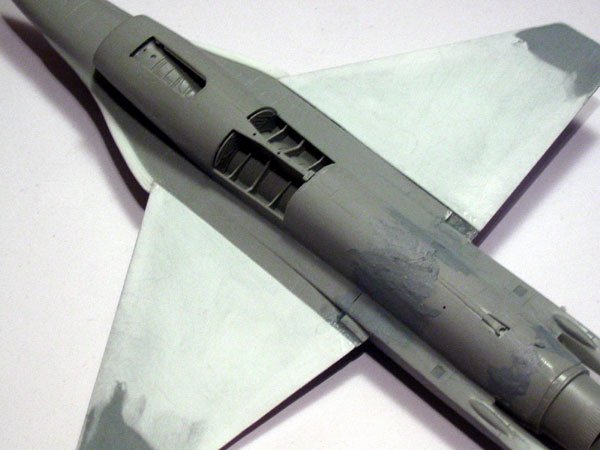
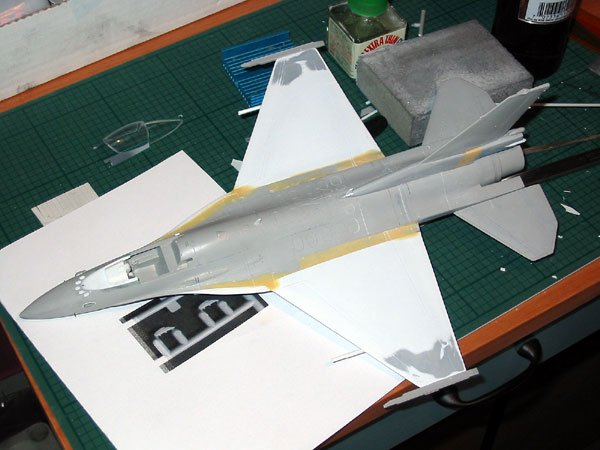
I scanned the Hasegawa wings and enlarged them
to 48 scale, had them printed out and reshaped 1/48 Italeri wings according to
these drawings. I used mostly 0.25mm (0.01 inch for the ones at the other side
of the pond) styrene, I filled all the gaps with resin. Same procedure was done
for the horizontal stabilisers. I scribed all the details on the wings, then
attached the wings to the fuselage using brass rods.
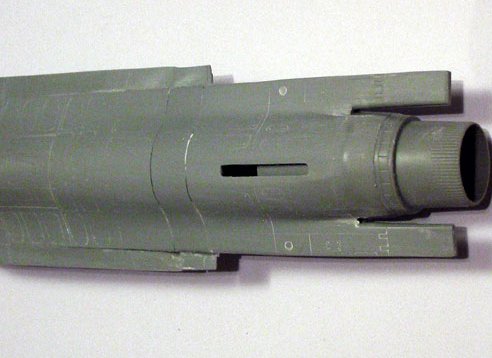
I filled all details on the fuselage with
putty and all gaps with Tamiya quick setting epoxy putty.
|
Click on
image below on right to see larger image
|
 |
 |
I took a lot of time (read days)
to sand and have the correct contour of the plane. While modifying the
cockpit, I did not touch side panels, I only enlarged front panel and added new
MFDs (Multi Function Displays), I also reshaped dashboard coaming to fit new
canopy. I used sheet styrene to add five aerials of IFF system right in front of
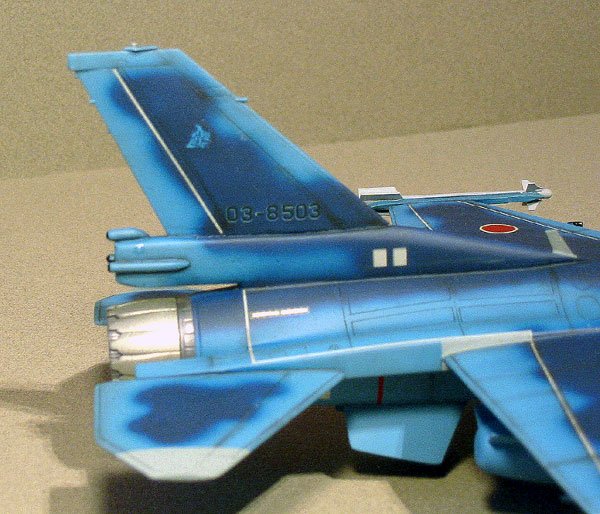
canopy. Even though tails do not differ much, it is a bit higher in F-2. I
modified an F-16C tail to enlarge the chute box and to