|
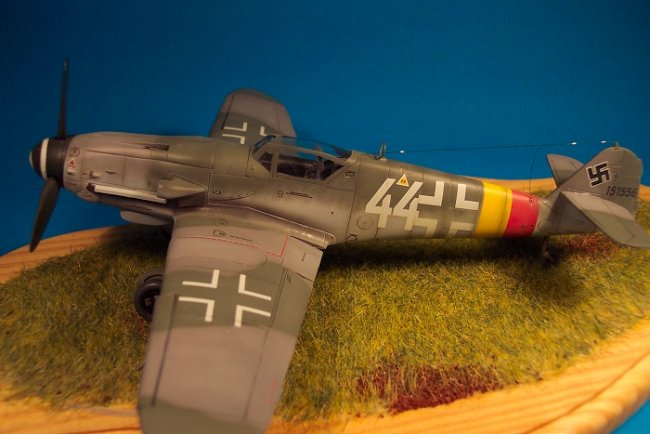
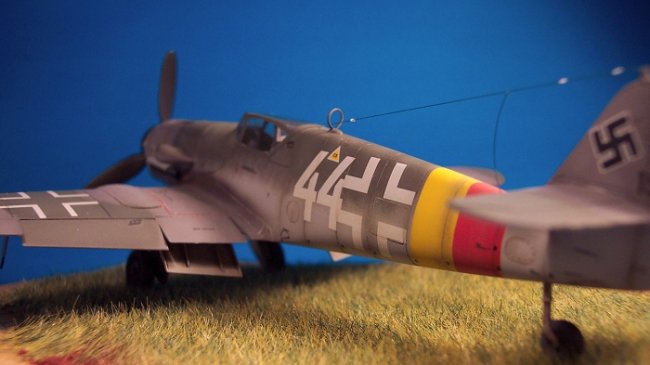
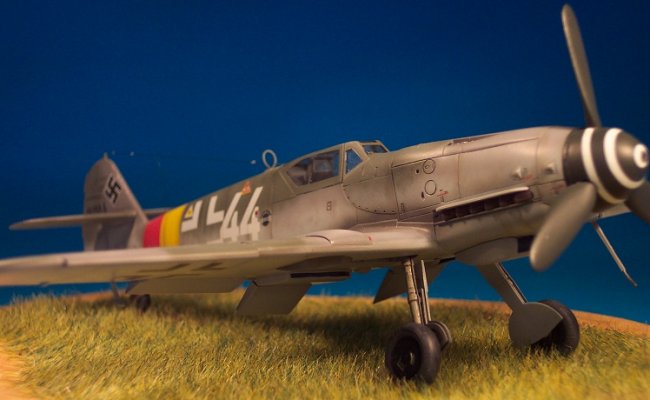
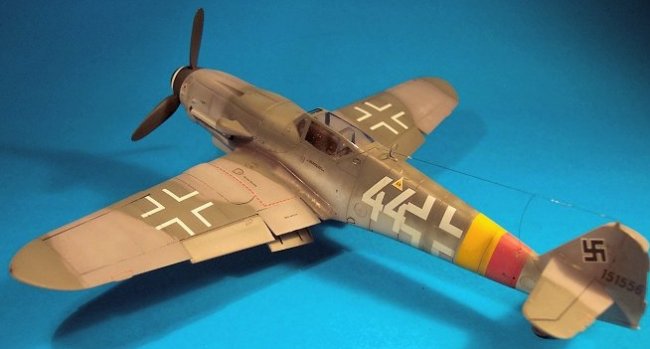
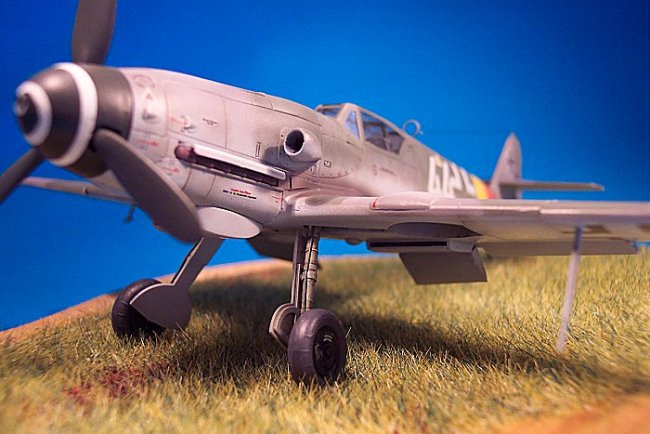
This is Hasegawa's 1:48 scale Bf109 G-10. Much has already
been reviewed about the Hasegawa line of Bf109's so I will stick to the build of
this kit. I chose to build it out of the box with some minor augmentations
such as adding seat belts from Extra Tech, fuse wire for brake lines, ribs made
from plastic card for the inside flaps and antennae wire from invisible thread.
The insulators are made from Krystal Clear. I followed the instructions
step by step with no need for filler. Primary steps include assembling the
cockpit, adding any details such as the seat belts, painting it as well as the
inside portions of the fuselage RLM 66 Dark Grey. Once painted I dry
brushed the raised details using a light grey mixture of oil paints. With
the cockpit painted, the major assembly of the kit can take place,
this includes gluing the fuselage and wing halves together as well
as the tail. I usually do not glue the landing gear on until they have
been detailed and painted, but I did use a small amount of 'Blue Tac' to hold
them in place to aid in painting later. I added some small ribs to the
inside lower flaps and glued them in the open position, the slats were glued in
the open position as well. All the small details were glued on except for
the antennae wire. The canopy was masked and glued in place, and the kit
was ready for painting.
|
Click on
images below to see larger images
|
|

|
 |

|
| Painting
the 109 G-10
My first choice was to
paint the G-10 in ANR colours, but I decided to save that for my G-14
kit, instead I opted for the 2nd choice on the instruction sheet.
I only used the instructions for camouflage placement, but I should
point out the colours on the instruction sheet are backwards on the
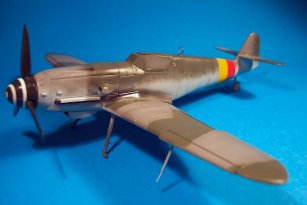
upper wings. I first painted the panel lines with matte black,
when this was dry I painted the RLM 76 right up to the top of the
fuselage. |
Click on
image below to see larger image
|
 |
|
The preshading
usually gets covered up on the sides but remains on the underwings and lower
fuselage, but this can be fixed later with post shading and fading.
After the RLM 76 has dried, I set my Aztek A470 at it's finest setting and
painted the RLM 75 Grey Violet on the upper wings as well as the upper fuselage.
As I brought the colour down I went lighter into the mottling. Some of the
camouflage may appear dark at first, but when both RLM 75 and 82 are applied you
can touch things up with the RLM 76. I allowed the RLM 75 to dry
over night and then made mask using post it notes. I blue tacked these
down leaving a tiny gap to allow a soft edge to be produced. Once in place
I painted the RLM 82. With the basic colours now on the model I mixed some
of the RLM 76 with the RLM 82 and RLM 75 and began lightly painting the centre
of the panels, this gives the model a weathered appeara nce without having to dry
brush or use allot of pastel chalk later. Once the fading was completed I
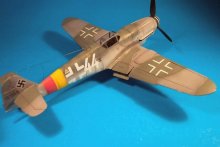
masked the fuselage and painted the RLM 04 and RLM 23 RV band of JG301. I
should point out at this stage that the kit instructions call for the decal to
be used which that of JG7, but from what I was told this plane was actually from
JG301.
With most of the painting done, all
that was left was masking and painting the wheel wells, the inside of the flaps,
and the struts with RLM 02 and painting the prop and spinner RLM 71.
When the paint had cured for a good two days, I used Pascoes Long Life and
applied it with a flat brush. This product is much like Future and is self
levelling. With the major parts of the aircraft glossed, I applied the
decals. The kit decals are a little on the thick side so solvent is needed
to help them settle into the panel lines. The final step in the finishing
is matte coating the plane and lightly weathering it. I use Tamiya Flat
Base mixed with Pascoes Long Life for the matte coat, this works pretty good and
allows me to increase or decrease the amount of dullness I desire. I used
a sharpened pencil for most of the panel lines, and a very thinned down black
and brown ink from Citadel's range of paints for the remainder of the washing.
I also added some pastels to tone down some of the weathering which I did with a
silver pencil. The final detail was adding the antennae wire which was
made from invisible thread and insulators made of Krystal Clear.
|
Click on
images below to see larger images
|
|
|
|

|
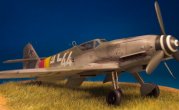 |
Final Notes: This was a
quick build and I basically wanted to stick to out of the box for the exception
of the minor details I added. I didn't have much reference material
to go by for this particular plane but from what I have been told, Eagle
Editions is going to be releasing a book very soon which will have some
interesting information about this aircraft "White 44". There is
also an article on Hyperscale
written by Floyd Werner that describes how to change the cowling on this kit to
the "Type 110 Variant". This being an aircraft from werknummer
block 150 would have had this type of cowling. I hope you like the
finished product, I enjoyed building it as most who enjoy the 109 do and it was
fun trying out some of the painting techniques I have been picking up reading
articles on Hyperscale and magazines.
Anthony
|
Click on
images below to see larger images
|
|
 |

|
 |
|
|