|
INTRODUCTION
In late 1937, designers at
Nakajima began work on a new fighter to replace the Ki-27 Nate. In just over a
year, the first prototype flew and subsequently began
service trails in 1939. Powered by the HA-25
Type 99 rated at 980hp, the 14-cylinder double-row radial engine, was one of the
best ever produced by Nakajima. An interesting note was the introduction of
mixed armament used. Basically, there were 2 different variations of either i)2x
7.7mm & ii)2x 12.7mm. According to some reliable references, early Oscars
came with mixed 1x 7.7mm & 1x 12.7mm guns fitted in
the cowling. Only late Oscars were
seen with black anti-glare panel on top of the cowling. The Oscar were
also seen with a variety of colour schemes. Field application were carried out
to spice up the dull-looking NMF airframes. Since no primer were applied,
many were seen with heavy paint chipping off the entire airframe.
Maximum speed of Ki-43-I is 495km/h, and a cruising
speed of around 320km/h. Maximum range was some 745
miles with 2 underwing drop tanks.
|
Click on
images below to see larger images
|
|

|
 |
BRIEF
HISTORY
When the Imperial Japanese Army (IJA) reached an agreement with the
neutral Siamese government, it marks the first step with the invasion by
IJA forces into Malaya. On 7 Dec 1941, a RAAF Hudson on a routine patrol spotted
an Imperial Japanese Navy (IJN) fleet comprising of a cruiser, some 4 destroyers
and a troopship. At around 2200hr, the IJA landed its first wave of troops,
probably combat engineers, in Kota Bahru. By then, a number of transports
were already waiting off the Siamese coast, preparing to land the initial
assault force of the IJA 5th Division. Many reports confirmed that RAF/RAAF
airstrips in northern Malaya were under heavy attacks by Imperial Japanese
Army Air Force (IJAAF) bombers, thus unable to repel the IJA landings. Ki-43-I
Oscars operating out of Singora were providing air cover for both naval and
landing troops from limited Allied offensives . Since no RAF/RAAF
fighters (i.e. Brewster Buffaloes) were capable of matching the Oscars,
the IJAAF achieved complete air superiority in northern Malaya.
Kota Bahru was the last line of defence for the British forces and with the
invading IJA forces mounting heavy offensives, the Allies had no choice but to
withdraw to Kulai Krai. Many airstrips were captured by Japanese
troops were converted for use by IJAAF. It was noted that Oscars from the 64th
Sentai may have been deployed to these forward areas. For the next 8
weeks or so, British forces were taking such heavy casualties
inflicted by the IJA forces, that they finally withdrew all units to
Singapore. With the deployment of Mitsubishi G3M3 Nells of the Mihoro and
Genzan Kokutai in Malaya, Singapore were soon bombed relentlessly until 15
Feb 1942, where the British forces, under General Arthur Percival surrendered to
IJA's General "Tiger of Malaya" Yamashita.
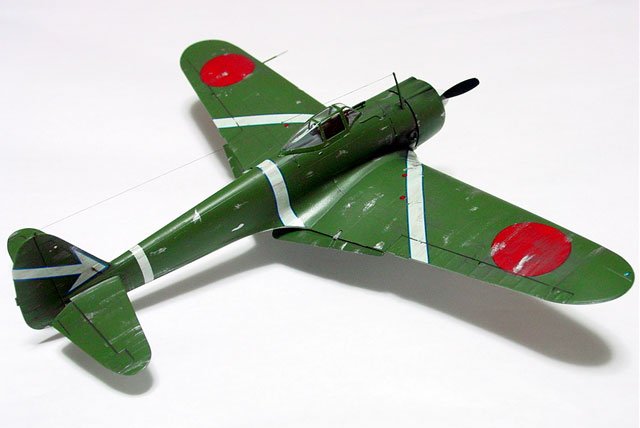
Markings
above depicts an example from the 64th Sentai. Note model has little chipping so
as to simulate new Oscars deployed to Malaya. However, these became worst
with prolonged exposure to high humidity, reducing it to an extent that
only the bare NMF surfaces were visible.
Please note there were errors in the colour profiles in the instruction sheet.
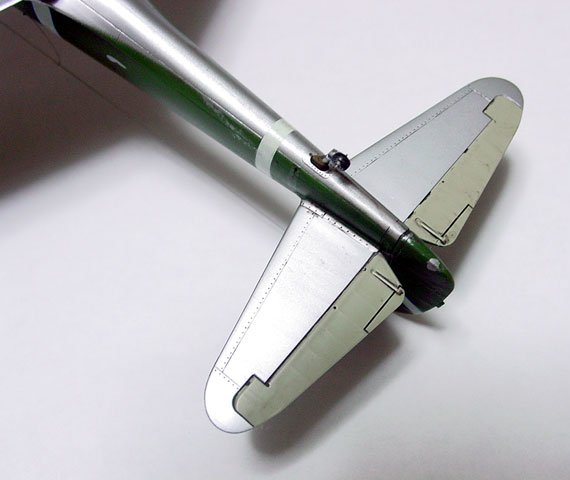
Main fuselage were painted with Gunze Mr. Color H129 Dark Green(Nakajima), NMF
for undersides. Some says it's IJA Green Gray but it is NOT! Since the Oscars
were operating in harsh tropical climate, the oxidized NMF under surfaces
appears to be gray. Early Oscars had their wheel wells/butterfly flaps in
NMF as well. Only late Oscars had these painted with blue aotake. IJA Green Gray
H128 were used on the underwing ailerons & tail horizontal stabilizers. Kit
decals were used. Hinomarus were only applied on wings while late Oscars had
them painted on the fuselage.
Cheers!
Sebastian L
Republic
of Singapore
|
Click on
images below to see larger images
|
|
|

|
|
|
|



 Fall of Singapore 62nd
Anniversary
Fall of Singapore 62nd
Anniversary