|
Hasegawa’s Jaguar
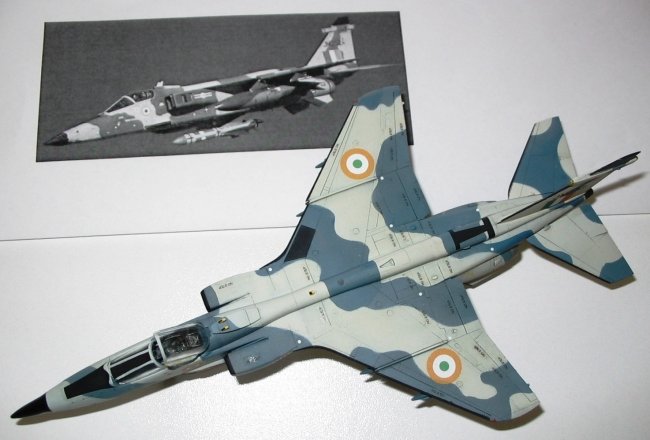
Gr.1/A kit provides the option to make the SEPECAT (Société européenne de
production de l'avion d'école de combat and d'appui tactique) Jaguar
International in the ground attack/strike configuration. However, a bit of putty
and judicious use of the hobby knife can convert the standard Jaguar Gr.1 to the
Indian Air Force’s unique Jaguar IM (International Maritime) aircraft.
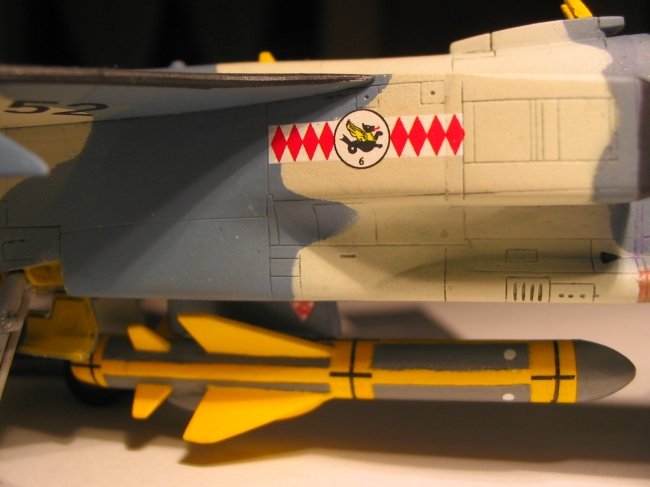
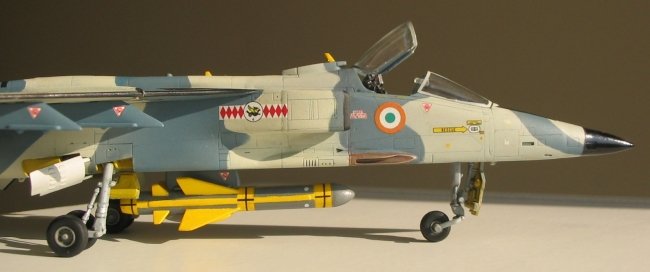
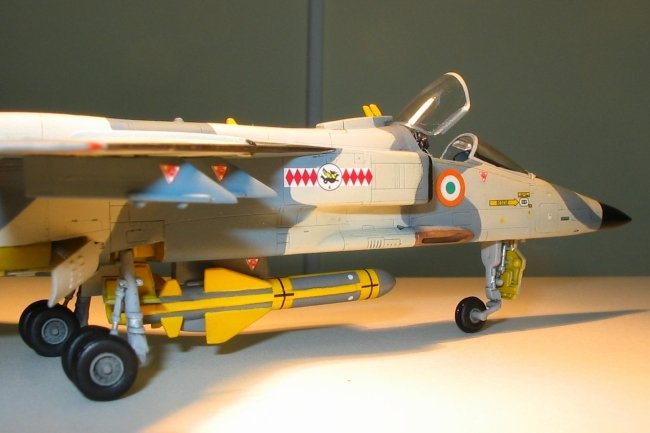
The Indian Air Force’s No. 6
squadron, Dragons, based in Pune has a dozen or so Jaguar IMs. The Jaguar IM has
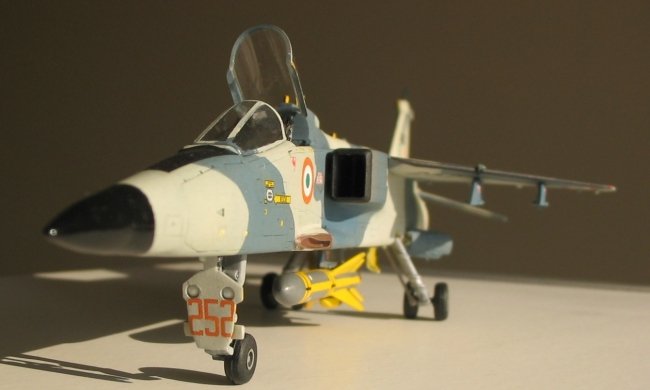
a similar external configuration as the Jaguar Gr.1 or IS except for the Agave
radar, which gives it a unique nose profile. When equipped with a Sea Eagle AShM
to fulfill its maritime strike role, the Jaguar IM can launch action against
ship-borne threats to India’s maritime assets.
| The No. 6,
Dragon, insignia, and Sea Eagle AshM |
Click on
image below to see larger image
|

|
|
Build/Modifications
The kit was completed pretty much
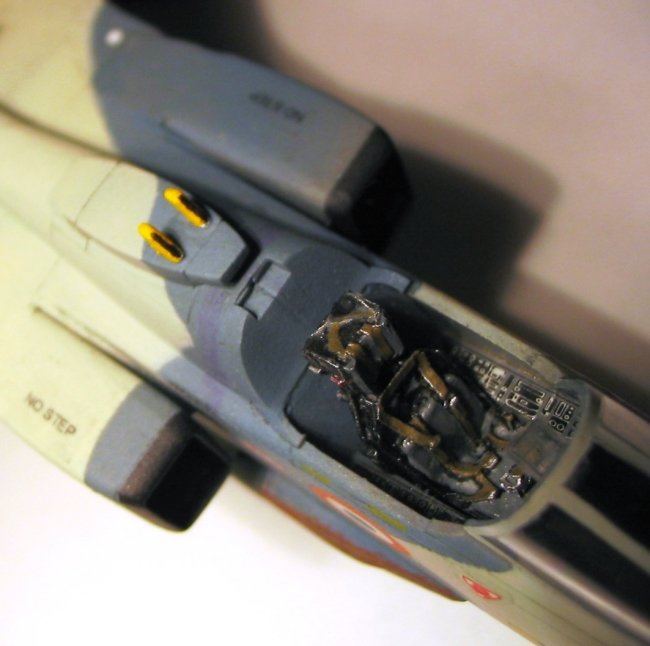
out of the box, with the exception of a Pavla Martin Baker Mk9 ejection seat
(the difference is amazing) and a Sea Eagles missile. The kit's Gr.1, or
"S", parts were used in the conversion to the IM. The modification of
the Hasegawa kit to the IM version began with the removal of several blade
antennas from the wings and fuselage, and the removal of the fins on the kit’s
Jaguar “S” tail below the RWR antennae. Unlike the British Jaguars, the
Indian Jaguars do not sport many of these antennae and fins. There is also a
mysterious bulge near the nose wheel-well that had to be removed.
The biggest modification involved
the nose. Thankfully, the kit comes with a separate nose section (so that one
can make either a Jaguar A, S, IS or, in my case, IM). Therefore, putty was
added in layers to the standard Jaguar S nose, built-up to the desired shape,
and sanded to look as close as possible to the IM’s. Line drawings of the IM
in Scale Aviation Modeller’s October 2001 issue were very helpful. Finally,
the conversion was complete with the addition of a Sea Eagle AShM swiped from
Hasegawa’s Sea Harrier FRS Mk. 1 kit.
The rest of the kit went together
well, except for the airbrakes. Hasegawa should be embarrassed by the lack of
the part’s fit with the fuselage and the improper angle at which they are in
the open position. The lack of air brake perforations is also unfortunate as the
cover art shows these prominently. On the plus side, the kit includes an
accurate access ladder and options to build at least three versions of the
Jaguar (A, S, or IS).
| The kit nose
cone was filled with putty and sanded to shape |
Click on
images below to see larger images
|

|
|
| A comparison of
the kit ejection seat and the Pavla replacement |
|
|
Click on
images below to see larger images
|
 |

|
Painting
Indian Air Force Jaguar IMs sported
a British-style two-tone medium and dark sea grey wrap-around pattern until a
few years ago, when it was replaced by the boring all-grey radar-absorbing
scheme. I elected to use the wrap-around scheme because the squadron insignia is
absent in the all-grey scheme. Frankly, I wanted to do a model with the
beautiful No. 6 Dragon squadron insignia.
I found the reference photos more
useful than Hasegawa’s painting guide. For example, the Indian Air Force
IM’s have black wing, tail, tail wing, antennae, and ventral fin edges. In
addition, there is a protective black panel fore of the tail. For the
wrap-around colors I settled on the darker color being a blend of dark sea grey
(Lifecolor from Italy) and intermediate blue (Model Master). The lighter color
was a combination of light camouflage grey (MM) and medium grey (MM). This is
the first time I used Lifecolor acrylics, and found them to be excellent. They
are non-toxic and are fabulous to brush-on or airbrush when thinned with Windex®.
Because the model was painted in several stages, the color tones vary like the
real aircraft in my references. Weathering was modest with the fuselage
receiving a wash of chalk and soapy water to bring out the nice panel lines.
After recoating the decals with Future®, I sealed the model with Testor’s
Lacquer Flat Coat (except for the nose, which was left in semi-gloss). Since
I am always looking to reduce the amount of time masking takes, I used
Eduard’s Jaguar A Express Mask for Italeri for the first time to mask off the
canopy and wheel oleos. The masks were useful for the wheels, but the fit around
the canopy was less than perfect.
Decals
The kit decals are very nice and
provide excellent stenciling for one complete British or French aircraft. For
the Indian Air Force markings, Mike Grant has printed beautiful decals for the
JM252 and JM257 aircrafts of the Dragons. The squadron insignia is printed
clearly in superb detail and looks great when on the aircraft. The only
shortcomings of the decals were minor: slightly under scale fin flash and
over-wing roundels, and slightly over scale serial marking on the nose wheel
door. I added some self-made decals including the two dozen “No Step”
warnings, the protective black panel just fore of the tail, and some white
warning markings to complete the stenciling. Decal-police will notice an error,
which I caught only after completing the model. If you are thinking of doing an
Indian Air Force Jaguar, write me and I’ll point it out so you can avoid the
same mistake.
Armaments
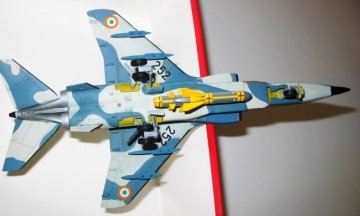
I finished the build with a training
round of the Sea Eagle AShM, which is attached to a modified centerline pylon.
While under-wing fuel tanks are common Jaguar issue on sorties, the kit did not
include any. Lacking spare fuel tanks, I excluded them. I also omitted the
kit-supplied Matra Magic air-to-air missiles because these are absent in photos
of aircraft carrying the Sea Eagle. The training rounds of the Sea Eagles in
Indian Air Force service have a yellow-on-dark sea grey scheme. I undertook the
tedious masking of the tiny missile and airbrushed Tamiya’s dark sea grey on a
base coat of enamel yellow. The stenciling on the Sea Eagles was done with home
made decals.
|
Click on
images below to see larger images
|
 |

|
References
Radek Simecek’s SEPECAT Jaguar in
detail web site on the Jaguar (an ARC link) is comprehensive and provides well
organized reference materials to accurately model the Jaguar. But, I could not
have completed this kit without several visits to the amazing Bharat-Rakshak
Indian Air Force web site.
http://sepecat.info/
http://www.bharat-rakshak.com/IAF/Images/Current/Jaguar2.html
http://www.bharat-rakshak.com/IAF/Info/Aircraft/Jaguar-25Yrs.html
http://www.kitreview.com/reviews/jaguardecalsreviewds_1.htm
(for a look at the decals)
Richard Caruana. "The Sepecat
Jaguar." Scale Aviation Modeller. October 2001.
Rupesh
|
|



 Indian air Force Day 2005