|
The
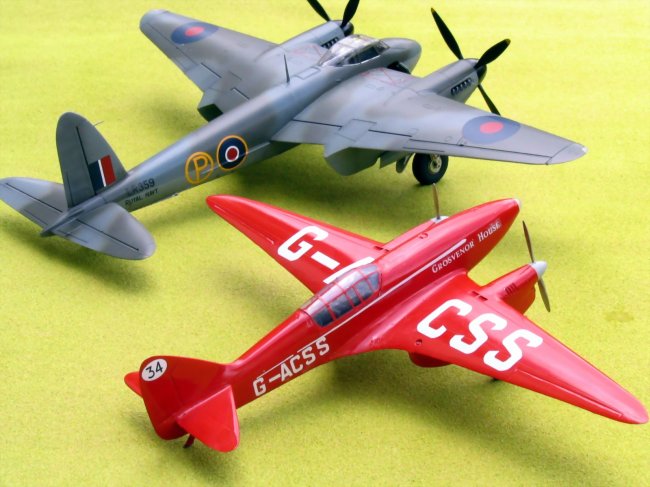
DH88 was purpose built for the London to Melbourne centenary air race in 1934.
With only 10 months to go before the race, Geoffrey De Havilland decided to
design and build the DH88 in order to win the trophy. Three planes were ordered
off the drawing board and entered the race. Of these, G-ACSS won the race
in 70 hours with an average speed of 160mph.
This
model is of the winning plane, sponsored by the Grosvenor House Hotel
(Pronounced Grovenor) in London. After winning the race it went on to set
further records for England to Cape Town and New Zealand before briefly serving
with the RAF. It lives on today in the Shuttleworth Collection in the UK where
it flies regularly.
|
Click on
images below to see larger images
|
|

|

|

|
Some
of the unique features of the plane were a stressed wooden skin, variable pitch
propellers, retractable undercarriage and flaps, all items only found on much
bigger planes at the time. All making this a significant aircraft from a design
as well as historic perspective. The fact that DH were able to build such a
plane in very short time speaks volumes for their ability as designers of
aircraft. This plane provides a link between the traditional DH biplanes of
the 1930's to the DH98 Mosquito series of the 1940's, as the mosquito used
a construction based heavily on that of the DH88.
The
kit is from Heritage aviation. It contained the basic airframe and
many small white metal parts, but no instructions! Also despite being
advertised as the "comet racer", it came with only the later RAF
decals. This required me to then buy a set of the correct decals, making it
a very expensive project in the end.
The fuselage resin was quite twisted
when I received it but this was easily straightened out by making a saw cut at
the rear of the cockpit into which I forced a piece of 0.040" plastic card.
Construction was a bit basic as I missed out many of the small pieces due
to lack of instructions. For reference I used photos on www.photobucket.com
which allowed me to build the undercarriage pretty close to the real thing. The
canopy was quite thick and I spent a long time sanding and polishing it to get
only an average final clarity. The tail planes are provided in white metal but
are somewhat different in size (see pic) so I built new ones from plastic
card and Milliput. I fitted the tail with a spar from brass rod
to get a strong joint.
|
Click on
images below to see larger images
|
|

|

|

|
A
lovely looking model of this beautiful and significant aircraft.
Thanks
to Photobucket.com for the reference pics,
Thanks
to "Whirly Bird Decals" for their excellent service in providing the final
decals,
The
reference details are from "Plane Makers 3 - De Havilland".
Colin
|