|
The
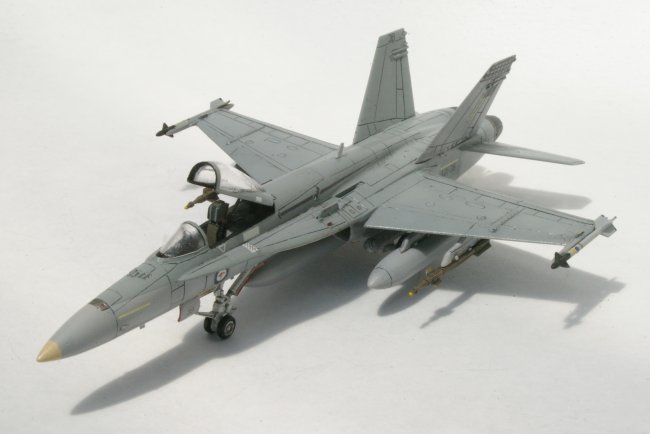
Royal Australian Air Force deployed 14 F/A-18A Hornets to the Middle East at the
beginning of 2003. As part of Operation Falconer these aircraft performed close
air support and strike missions over Iraq. These Hornets flew more than 350
sorties and dropped over 120 laser guided bombs supporting coalition units
operating in the south of Iraq.
I
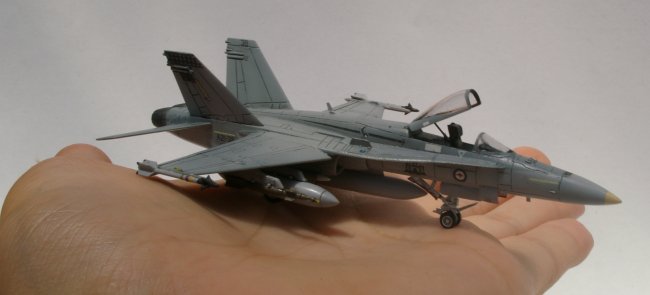
decided to build one of these Hornets in 1/144th scale. I found a company called
Novascale (Aussie Decals sold via eBay) that makes decals many RAAF subjects in
1/144 scale included markings for Operation Falconer in one of their F/A-18
sets.
I
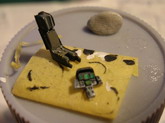
started out with the Revell F/A-18C kit. The kit is generally quite good with
some nice detail, but there is also room for improvement. I started the with the
cockpit. I replaced the kit ejector seat with a trimmed down seat taken from a
Dragon Super Hornet (you get two seats with each kit, even in the single seater
boxings). I added some detail to the control panel by cutting up some sequins
and using them to represent the multifunction displays.
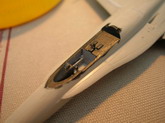
I'd
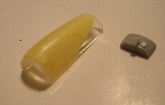
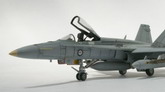
decided that I wanted to display the model with its canopy open. This meant
building the actuator and adding some detail to the canopy itself. A hud was
made from some clear plastic sheet.
As
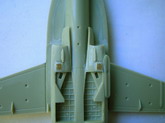
this model was to depict a parked and powered down aircraft, I set about
drooping all the control surfaces. This required a bit of cutting and sanding. I
also replaced the LEX fences with some plastic card, and added wingtip formation
lights.
Click on
images below to see larger images
The
kits intakes were not quite the right shape so I went about correcting them. The
kit also omitted and chaff/flare launchers. I added these by cutting some spare
photoetch mesh to shape, and fairing it in with some Mr Surfacer. Also added
were some ECM bumps under the intakes, these were made from stretched sprue. On
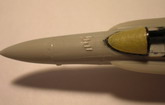
the nose I added the "bird slicer" antennas, these were made from
stretched evergreen plastic strip.
The
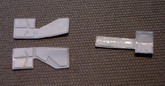
gear doors supplied with the kit were far too thick for the scale. In order to
make thinner replacements I used the kit parts as masters, heated up some
plastic sheet and pressed the kit parts through. I made two copies of each, so I
could cut up one to make details for the insides of the doors.
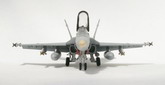
Landing
gear struts and the main wheels were replaced with those from the Dragon Super
Hornet. The nose wheels were copies of Revell's F-14 nose wheels.
I
used Gunze paints to paint my Hornet. The undersides were painted with H308
(FS36375 light ghost grey) and the upper surfaces with H307 (FS36320 dark ghost
grey), as per the normal tactical paint scheme. The tip of the nose was painted
with H318 Radome. I did some pre-shading to try and break up the colour a little
bit.
Most
of the markings came from the Novascale set. These are ALPS printed decals, so
some care is required when applying them. The warning placards around the
cockpit were leftover from a Dragon Super Hornet. The wingwalks on the tails and
LEX's, as well as the position lights came from a MYK decal set.
Operation
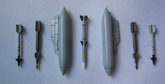
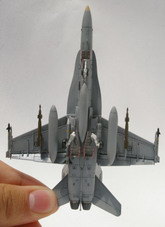
Falconer Hornets typically carried three drop tanks, two GBU-10/12, two
sidewinders, an AMRAAM and an AAS-38 Nite Hawk pod. I only had one spare extra
Hornet drop tank, so the additional tank was made from the rounded halves from
two F-14 drop tanks with extra material added to the rear and sanded to a point.
The targeting pod and bombs were (again) taken from a Dragon Super Hornet, and
the AMRAAM was a sparrow from the spares box with its wings clipped down. The
sidewinders came with the kit, but I added arming stencils from Revell's F-14D
decal sheet.
To
finish off I applied a wash using Pro Modeller Dark Weathering Wash, and sealed
everything with a semi matte coat. Last of all I added the various blade
antennas around the airframe.
I
had a lot of fun adding detail to this kit, and I'm quite pleased with the way
it turned out.
Christopher Cooper
Click on
images below to see larger images
|